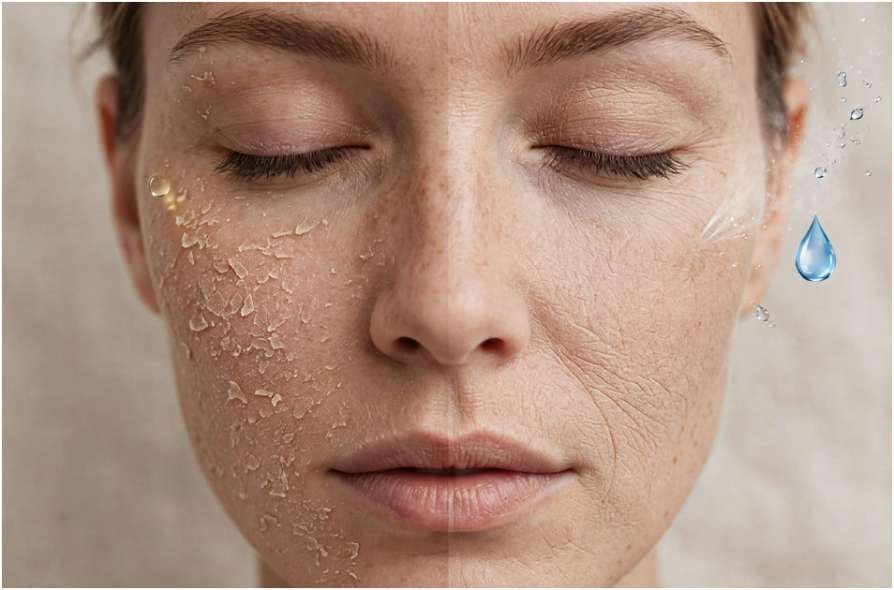
I spent two years treating my flaky, breakout-prone cheeks with heavy plant butters, only to watch my congestion worsen while the tightness remained. My mistake was simple: I failed to grasp the difference between dry skin and dehydrated skin.
+————————————————————-+
| THE CORE CONFLICT |
| |
| DRY SKIN (Type) DEHYDRATED SKIN (State) |
| Underactive Sebaceous Glands Compromised Stratum |
| Deficient in sebum & lipids Corneum water retention |
| |
| [Needs: Oil / Barrier Balms] [Needs: Water / Humectant]|
+————————————————————-+
One is an inherent genetic identity requiring oil; the other is a physiological state desperate for water. Once you recognize which deficit your barrier faces, choosing the right formulation shifts from confusing guesswork to predictable science.
The Fundamental Divide: Oil Deficiency vs. Water Depletion
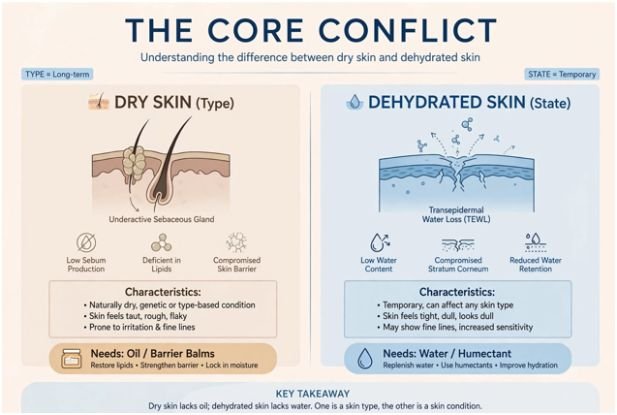
Skin comfort relies on two distinct elements: lipid integrity and water volume within the stratum corneum. Conflating these elements leads to counterproductive routines.
Dry Skin: A Biological Skin Type Lacking Lipids
Dry skin (clinically termed alipidic skin) means your sebaceous glands produce minimal sebum. Sebum waterproofs the skin and keeps cellular tiles glued together. According to the American Academy of Dermatology, individuals with dry skin maintain low lipid production across their entire anatomy, including the scalp, elbows, and hands.
Pores appear virtually invisible because sebum flow does not dilate follicular walls. Without adequate natural oils, the skin barrier becomes brittle, exhibiting persistent micro-cracking and scaling regardless of climate.
Dehydrated Skin: A Treatable Condition Driven by TEWL
Dehydration reflects a depletion of water within the epidermal layers, driven by accelerated transepidermal water loss (TEWL). Clinical research indexed by the National Center for Biotechnology Information highlights that TEWL occurs when environmental or mechanical aggressors disrupt intracellular cohesion, allowing hydration to evaporate into ambient air.
Dehydration spares no skin type; oily, normal, and combination profiles regularly experience it. When water reserves plunge, your skin often overproduces surface sebum to compensate. This reaction creates an oily surface stretched over a tight, desiccated foundation.
Side-by-Side Diagnostic Comparison
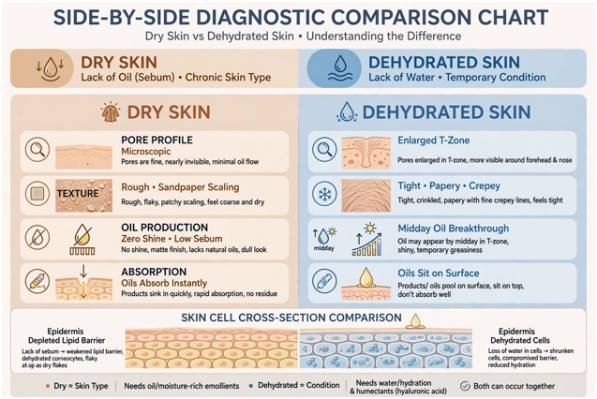
Evaluating visible markers alongside tactile responses clarifies your current barrier status.
| Diagnostic Marker | Dry Skin (Alipidic Type) | Dehydrated Skin (Water-Deficient Condition) |
| Root Deficiency | Natural sebum, essential fatty acids, ceramides | Intracellular water within the stratum corneum |
| Origin | Genetic blueprint; lifelong biological profile | Environmental, dietary, or behavioral triggers |
| Pore Profile | Microscopic or invisible over entire face | Variable; often enlarged or congested in the T-zone |
| Tactile Texture | Rough, sandpaper-like, rough scaling | Tight, papery, crepey surface tension |
| Oil Production | Near zero; no afternoon shine | Moderate to excessive midday oil breakthrough |
| Absorption Speed | Absorbs rich facial oils instantly | Oils sit atop surface while tightness persists |
| Breakout Frequency | Rare, except from occlusive-induced dermatitis | Common; micro-comedones underneath tight skin |
My At-Home Diagnostic Framework: The Sebum-Pinch Assessment
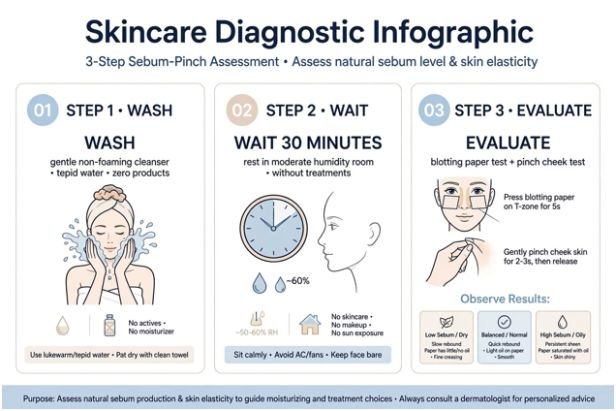
To eliminate trial-and-error routines, I use a diagnostic protocol that pairs tissue blotting with kinetic skin testing.
STEP 1: WASH STEP 2: WAIT STEP 3: EVALUATE
+————————+ +————————+ +——————————-+
| Gentle, non-foaming | —> | Wait 30 minutes in an | —> | Apply blotting paper to nose; |
| cleansing with tepid | | unheated, moderate- | | gently pinch cheek skin to |
| water. Apply zero | | humidity room without | | observe tensile response and |
| topical products. | | applying treatments. | | recoil elasticity. |
+————————+ +————————+ +——————————-+
- Cleanse with a mild, non-foaming wash using lukewarm water. Pat dry and leave the skin bare for thirty minutes.
- Press a single sheet of blotting paper firmly against your forehead and the bridge of your nose.
- Gently pinch the flesh of your upper cheek between your thumb and forefinger, holding for two seconds before releasing.
Interpreting Your Results
- The Dry Profile: The blotting paper shows zero translucent oil marks. The cheek pinch feels soft, yet the surface shows rough flaking without visible recoil lag.
- The Dehydrated Profile: The blotting paper reveals visible oil, particularly across the T-zone. During the pinch, the surface displays fine horizontal wrinkles like crinkled cellophane before snapping back.
- The Compounded State: No oil registers on the blotting sheet, and the pinch test reveals fine accordion lines that slowly recover. Here, your barrier lacks both lipids and water.
Targeted Ingredient Protocols: Lipids vs. Humectants
Resolving these issues requires distinct biochemical strategies.
| Functional Category | Primary Role | Ideal Target Candidates | Representative Ingredients |
| Humectants | Draw atmospheric and dermal water into cells | Dehydrated complexions, crepey texture | Glycerin, Hyaluronic Acid, Sodium PCA, Polyglutamic Acid |
| Emollients | Fill micro-fissures between desquamating cells | Rough, scaling, alipidic dry skin | Squalane, Ceramides (NP, AP, EOP), Cholesterol, Jojoba Oil |
| Occlusives | Form a hydrophobic film to stop TEWL | Compromised barriers, overnight moisture sealing | Petrolatum, Shea Butter, Lanolin, Dimethicone |
Rebuilding Alipidic Skin with Emollients and Occlusives
Treating genuine dryness requires supplementing missing sebum. Clinical guidelines from CeraVe Research demonstrate that replenishing physiological lipid ratios—specifically ceramides, cholesterol, and free fatty acids—restores protective resilience.
I apply facial oils and dense emollient balms morning and night. After washing, I mist my face with the best hydrating toner for sensitive dry skin to soften the stratum corneum, followed immediately by squalane and a lipid-rich cream to lock in the surface.
DRY SKIN ROUTINE DEHYDRATED SKIN ROUTINE
+—————————–+ +—————————–+
| Cream Cleanser (Non-Foam) | | Micellar Water / Gentle Gel |
| | | | | |
| Lipid Barrier Toner | | Humectant Essence on Wet |
| | | | Skin (Glycerin/HA) |
| Plant Oil (Squalane/Marula) | | | |
| | | | Water-Gel Fluid Moisturizer |
| Rich Ceramide Barrier Balm | | | |
| | | Occlusive Sleeping Mask |
+—————————–+ +—————————–+
Quenching Water-Starved Cells with Layered Humectants
Dehydration requires a different technique. Applying heavy oils directly over dehydrated skin creates a greasy, suffocated surface over tight, parched tissue. Instead, prioritize low-molecular humectants that bind water molecules.
Educators at Dermalogica recommend misting humectant solutions directly over damp skin to prevent the ingredients from pulling moisture outward from the dermis. I saturate clean skin with glycerin serums, seal with a light gel-cream, and finish twice a week with the best overnight sleeping mask for dehydrated skin to limit night-time TEWL.
Frequently Asked Questions
1. Can oily skin be dehydrated?
Yes; inadequate moisture levels disrupt skin equilibrium, causing excess oil production over tight, water-depleted tissue.
2. How quickly can skin dehydration be reversed?
Dehydration often improves within 48 to 72 hours of using targeted humectants and eliminating harsh foaming agents.
3. Does drinking water cure dry skin?
Drinking water supports systemic hydration, but it cannot correct dry skin caused by low genetic sebum production.
4. Can over-exfoliation turn dry skin into dehydrated skin?
Aggressive acids strip the lipid barrier and damage corneocyte structures, accelerating water loss and triggering severe dehydration.
Stop Guessing, Start Repairing
Stop treating your skin based on surface assumptions. If your face feels tight yet shines by midday, replenish water reserves with layered humectants on damp skin. If your skin stays matte, rough, and thirsty for heavy oils, focus on rebuilding lipids with ceramides and plant butters. Listen to what your barrier is missing, feed it the correct nutrient, and balance will follow.
Leave a Reply