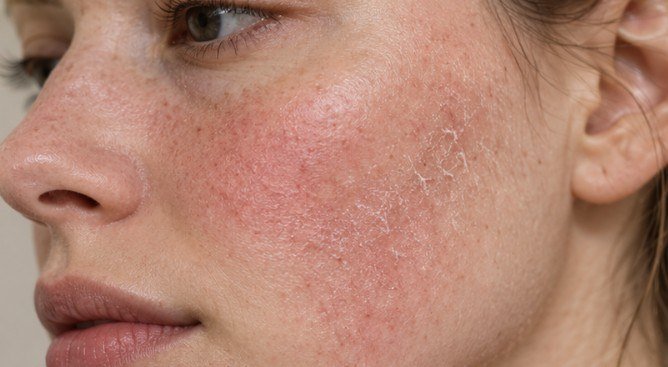
The first clue that exfoliation has gone too far is often not peeling—it is water suddenly stinging your face. That matters because an overworked stratum corneum loses some of its ability to keep water in and irritants out. If you are learning how to repair skin barrier after over exfoliating, the fastest route is usually subtraction: stop acids, scrubs, retinoids, and other irritating actives, then give skin several quiet days of cleansing, moisturizing, and sun protection.
The American Academy of Dermatology’s safe-exfoliation guidance warns that over-exfoliation can leave skin red and irritated, especially when exfoliants are combined with retinoids, benzoyl peroxide, or other products that already increase sensitivity.
What Over-Exfoliation Actually Does
The stratum corneum is not simply dead material waiting to be scrubbed away. It is an organized barrier made of corneocytes surrounded by lipids, including ceramides, cholesterol, and fatty acids. Together, these structures slow transepidermal water loss and help prevent irritants from penetrating easily.
Research on barrier biology shows that moisturizers support this system in different ways. Humectants attract and retain water, emollients smooth the spaces around skin cells, and occlusives reduce evaporation. Ceramides are particularly relevant because they are naturally present within the stratum corneum.
Over-exfoliating can disturb that arrangement. Chemical acids may remove too much surface material, while brushes, scrubs, or rough towels add mechanical friction. The result may be tightness, unusual shine, burning, flaking, tenderness, or redness after products that normally feel comfortable.
Harvard Health’s dermatology review of exfoliation notes that excessive or aggressive exfoliation can trigger irritant contact dermatitis and increase susceptibility to sunburn. Scrubbing away visible flakes can therefore prolong the problem rather than solve it.
A Five-Step Barrier Reset
1. Pause the Entire Active Routine
Stop alpha-hydroxy acids, beta-hydroxy acids, facial scrubs, peeling pads, retinoids, benzoyl peroxide, strong vitamin C formulas, and anything that noticeably stings.
You are not abandoning those ingredients permanently. You are removing unnecessary variables while your barrier settles. If even lukewarm water burns, that is a good reason to simplify further.
2. Cleanse Gently
Use lukewarm water and a mild, fragrance-free cleanser. Avoid cleansing brushes, rough washcloths, hot water, and prolonged washing.
If your face is not particularly oily in the morning, rinsing with lukewarm water may be enough temporarily. At night, cleanse gently to remove sunscreen, sweat, makeup, and environmental residue.
3. Moisturize While Skin Is Slightly Damp
A simple cream or ointment is usually more useful during recovery than a long sequence of serums. Useful ingredients can include glycerin, hyaluronic acid, ceramides, petrolatum, dimethicone, cholesterol, and fatty acids.
A PubMed review on moisturization and skin-barrier repair explains that humectants increase hydration, emollients support the skin surface, and occlusives reduce water loss.
ColumbiaDoctors’ barrier-repair moisturizer guidance also notes that ceramide-containing moisturizers can help reduce water loss and support rebuilding of the skin’s protective barrier.
For especially dry patches, a thin layer of a bland occlusive such as petrolatum can help limit evaporation. There is rarely a need to introduce several new “repair” products simultaneously.
4. Protect Recovering Skin From UV Exposure
Irritated skin is already dealing with one stressor, so unnecessary ultraviolet exposure can make recovery harder.
The FDA’s sun-safety guidance recommends broad-spectrum sunscreen and states that SPF 30 or higher is recommended for stronger protection.
Choose a sunscreen that does not cause persistent burning when applied. Hats, shade, and reducing direct exposure during strong midday sun are also useful while your skincare routine is stripped back.
5. Reintroduce Actives One at a Time
Do not restart exfoliation simply because the visible flakes disappeared yesterday. Wait until washing, moisturizing, and applying sunscreen no longer sting and your skin has remained comfortable for several days.
Then introduce one active at a lower frequency. An exfoliant previously used every day, for example, might return only once a week initially.
If burning, persistent redness, or peeling returns, stop again.
How Long Does an Over-Exfoliated Barrier Take to Heal?
There is no universal countdown. Controlled research in which human facial skin was deliberately disrupted through tape stripping found that some measurable barrier recovery was already occurring 24 hours later. Try beta glucan vs hyaluronic acid for acne prone skin. Real-world over-exfoliation, however, varies greatly according to acid strength, frequency, friction, skin condition, and the number of irritating products being combined.
| What You Notice | Practical Recovery Estimate | Best Response |
| Mild tightness or light stinging | Often improves within several days | Keep the routine minimal |
| Persistent redness, flaking, or burning | May need roughly one to two weeks | Avoid actives and friction |
| Raw, cracked, oozing, or very painful skin | Can take several weeks and may be more than over-exfoliation | Seek medical evaluation |
These are practical estimates, not medical deadlines. Eczema, allergic contact dermatitis, rosacea, perioral dermatitis, infection, and reactions to individual ingredients can all be mistaken for a damaged barrier.

A Simple Home Check Before Restarting Actives
Before bringing exfoliants back, ask yourself four questions.
Does lukewarm water sting? Does a bland moisturizer keep burning after application? Is your skin still unusually red or hot? Is there cracking, crusting, swelling, blistering, or oozing?
If water and basic moisturizer feel normal and your skin has remained calm for several days, cautious reintroduction is more reasonable.
Blistering, oozing, marked swelling, worsening pain, or rapidly spreading irritation deserve professional evaluation. The American Academy of Dermatology lists burning, tenderness, excessive dryness, swelling, and fluid-filled or oozing blisters among possible signs of contact dermatitis.
What Not to Do During Recovery
The biggest mistake is trying to treat every symptom separately.
Peeling prompts another exfoliation. Redness prompts three soothing serums. Breakouts prompt salicylic acid or benzoyl peroxide. Before long, already-irritated skin is dealing with several new variables.
Keep recovery boring.
Avoid fragranced products, essential oils, clay masks, peel-off masks, scrubbing tools, hot water, and DIY acid treatments until normal tolerance returns. “Natural” does not automatically mean non-irritating; fragrances are a well-recognized cause of cosmetic contact dermatitis.
Topical steroids should not become a do-it-yourself facial barrier treatment either. They may be appropriate for specific diagnosed inflammatory conditions, but persistent facial inflammation deserves proper assessment.
How to Repair Skin Barrier After Over Exfoliating Without Repeating the Damage

Once your skin feels normal, investigate what happened before the flare.
Did you move to a stronger acid? Combine an exfoliating acid with a retinoid? Start exfoliating every day? Add a scrub or cleansing brush? Introduce several brightening or acne treatments together?
Change one variable at a time during your restart. That makes it much easier to identify what your skin actually tolerates.
The American Academy of Dermatology advises adjusting exfoliation frequency according to skin type and exfoliation method. In general, the more aggressive the exfoliation, the less frequently it should be performed.
Frequently Asked Questions
1. Can I use hyaluronic acid on an over-exfoliated barrier?
Usually, if the formula does not sting or contain irritating extras. Hyaluronic acid is a humectant, but it is most useful when followed by a moisturizer that reduces water loss.
2. Should I use ceramides after over-exfoliating?
Yes, they may help because ceramides are normal components of the stratum corneum. Choose a simple, fragrance-free moisturizer instead of layering several new barrier products.
3. Can I exfoliate peeling skin while it heals?
No. Peeling is not a signal that your skin needs additional exfoliation. Continuing chemical or physical exfoliation can extend irritation and delay normal tolerance.
4. When should I see a dermatologist?
Seek care for blistering, oozing, crusting, major swelling, severe pain, eye-area involvement, signs of infection, or irritation that continues worsening despite stopping exfoliation.
The Best Recovery Routine Is Usually the Shortest One
The counterintuitive part of barrier repair is that improvement often comes from doing less. If your face suddenly stings after weeks of acids, retinoids, scrubs, or layered treatments, the answer is rarely another active ingredient.
Give the stratum corneum what it actually needs: less friction, less chemical stress, adequate moisture, and consistent UV protection. Once comfort returns, rebuild your routine slowly rather than returning immediately to the schedule that caused the irritation.
The best proof that your barrier has recovered is not reaching a specific day on the calendar. It is when ordinary cleansing, moisturizer, and sunscreen finally feel ordinary again.
Leave a Reply