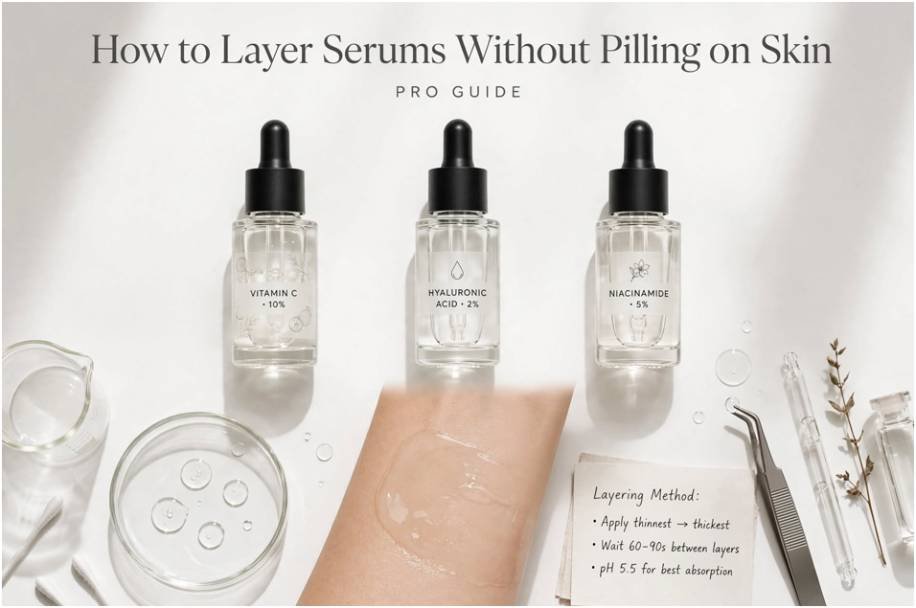
I spent years ruining expensive morning routines before I understood why my face produced tiny grey rubbery flakes thirty seconds after applying sunscreen. If you want to master how to layer serums without pilling on skin, you must treat your regimen like physical chemistry rather than a casual paint job. Pilling happens when topically applied products fail to penetrate the stratum corneum, coagulate on the surface, and ball up under mechanical friction.
Understanding molecular weights, carrier bases, and polymer cross-linking changes everything. When I adjusted my application timing and mapped out formula weights, product balling stopped completely.
The Chemistry Behind Why Your Skincare Rolls Off
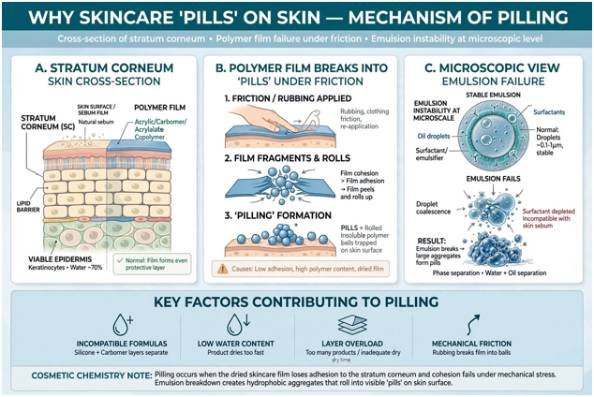
Pilling is not skin peeling; it is an emulsion failure occurring on the epidermis. Topical formulations rely on specific carrier matrices to stay suspended in a bottle. Once applied to your skin, these vehicles evaporate or absorb, leaving behind active compounds alongside film-forming agents.
According to research documented by the National Center for Biotechnology Information (NCBI), the stratum corneum regulates transdermal flux based on lipid solubility and molecular size. When incompatible ingredients stack up, absorption halts, and surface tension causes the layers to shear into visible balls.
The Polymer Trap: Carbomers, Gums, and Cross-Polymers
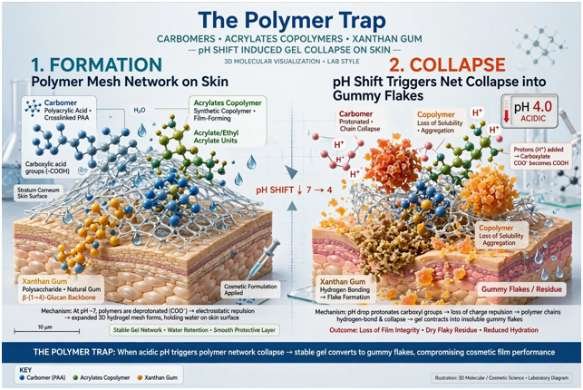
Silicones usually take all the blame, but synthetic thickeners cause just as many issues. Cosmetic chemists rely heavily on carbomers, acrylates copolymers, and xanthan gum to create rich, silky textures out of inexpensive water. Assessments by the Cosmetic Ingredient Review (CIR) show that these cross-linked polymers create flexible, breathable surface meshes.
Trouble begins when you layer a low-pH active acid over an acrylates-thickened gel. The sudden shift in pH and electrolyte concentration collapses the polymer net. The gel destabilizes, turns gummy, and flakes off in shreds.
Silicone Barriers and Incompatible Bases
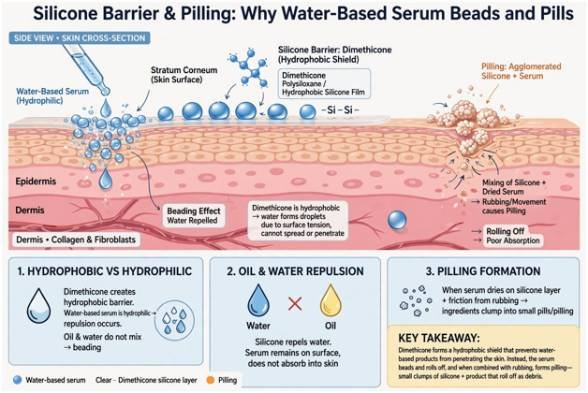
Silicones like dimethicone, cyclopentasiloxane, and cyclohexasiloxane form a protective, hydrophobic shield over the skin. Clinical reviews in the Journal of Clinical and Aesthetic Dermatology (JCAD) highlight silicones for their exceptional barrier protection and transepidermal water-loss prevention.
However, water and oil do not mix without rigorous emulsification. When you rub a water-dense humectant over a cured silicone layer, the aqueous solution cannot penetrate the hydrophobic film. Friction sweeps the unabsorbed water layer across the silicone shield, causing it to roll into synthetic debris.
The Step-by-Step Blueprint for Friction-Free Layering
The American Academy of Dermatology (AAD) advises applying products from lightest to heaviest consistency. You must refine that rule by looking at water content, volatility, and active molecule delivery.
Step 1: Low-pH Aqueous Actives (Dry Skin)
↓ (Wait 60 seconds)
Step 2: Viscous Humectants & Hydrators (Pat into place)
↓ (Wait 45 seconds)
Step 3: Emulsions & Lipid Treatments (Light press)
↓ (Wait 60 seconds)
Step 4: Occlusive Creams, Silicones & Sunscreen
Master the Viscosity Gradient
Always lead with water-thin active liquids. Pure L-ascorbic acid, salicylic acid, and liquid exfoliating toners require unimpeded access to your lipid mantle. If you are tracking how long does it take for vitamin c serum to work, applying it after a viscous hyaluronic acid gel will delay your progress by impeding cellular delivery. High-viscosity gels should follow low-viscosity solutions.
Calibrate Skin Moisture: Dry vs. Damp Application
Many skincare enthusiasts follow the blanket advice to apply everything onto damp skin. This single mistake triggers chronic pilling and severe barrier irritation.
Humectants like glycerin and hyaluronic acid bond with water molecules and thrive on slightly damp skin. Conversely, direct acids, high-strength retinoids, and L-ascorbic acid destabilize on wet skin, increasing irritation risks. If you are managing a skincare routine for broken skin barrier and redness, apply soothing barrier serums only to dry or slightly misted skin without rubbing.
Decoding Product Clashes: The Compatibility Matrix
Preventing pilling requires knowing which formulation bases complement each other and which destabilize on contact.
| Active / Vehicle Type | Formulation Base | Incompatible Partner Layer | Why It Destabilizes |
| Pure Vitamin C (L-AA) | Low-pH Aqueous | Carbomer-heavy gel serums | pH shift breaks polymer suspension |
| High MW Hyaluronic Acid | Water-soluble polymer film | Water-resistant primers | Film sheds under subsequent friction |
| Niacinamide (5–10%) | Water-gel emulsion | Volatile cyclic silicones | Emulsifier separation causes clumping |
| Retinol Suspensions | Squalane / Lipid base | Dense aqueous hyaluronic acid | Hydrophobic repulsion blocks penetration |
| Zinc Oxide Mineral SPF | Inorganic physical shield | Unabsorbed facial oils | Pigment suspends in oil and shears off |
Technique Adjustments That Stop Balling Instantly
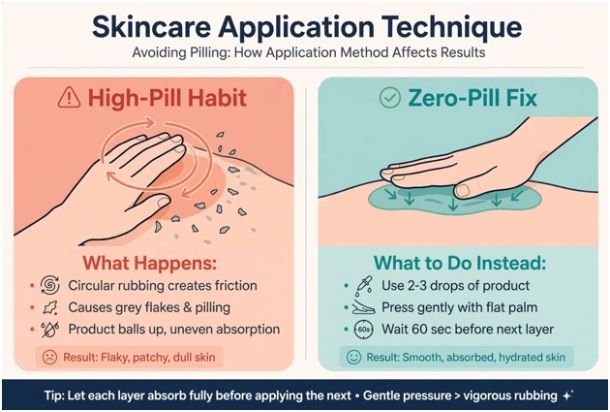
The mechanical motion you use dictates whether serums settle into pores or tear apart at the surface. Replace circular buffing motions with targeted pressing.
| Application Variable | The High-Pill Habit | The Zero-Pill Fix |
| Application Motion | Vigorous circular rubbing | Firm, flat-palmed pressing |
| Dosing Size | Full dropper (6–8 drops) | 2–3 concentrated drops total |
| Wait Intervals | Wet-on-wet stacking (<10s) | 45–60 seconds between phases |
| Tool Usage | Rolling with jade/metal tools | Finger pads only for distribution |
Dispense two to three drops across your fingertips, distribute evenly, and press your palms flat against your cheeks, forehead, and chin. Allow the solvent carriers thirty to sixty seconds to evaporate naturally before introducing the next layer.
Frequently Asked Questions About Serum Pilling
1. Why does my niacinamide serum always pill under moisturizer?
High-percentage niacinamide often relies on thick xanthan gum binders that flake when dragged under thick moisturizing creams.
2. Can I mix two serums in my palms to avoid layering?
No, blending two finished formulations directly in your hands destabilizes their individual preservative systems and emulsifiers before they reach your face.
3. Does dead skin cause skincare pilling?
Desquamating dead skin cells can mix with unabsorbed product residue, but synthetic polymer breakdown causes over 90% of visible skincare pilling.
4. Why does sunscreen pill over certain morning serums?
Chemical and mineral sunscreen filters require an undisturbed film to set; heavy humectant gels underneath disrupt this film formation.
Drop the Rubbing, Keep the Results
Skincare pilling is an application error, not an inevitability. When you stop overloading thick synthetic gels, respect molecular drying windows, and press formulas instead of rubbing them, your routine glides on cleanly every time. Strip back your stack to two high-performance serums, allow each formula to settle, and let chemistry do the heavy lifting.
Leave a Reply