I spent years assuming a tight, flaky face simply meant I needed more humectants. I flooded my complexion with watery serums, only to watch my skin become tighter, redder, and increasingly reactive.
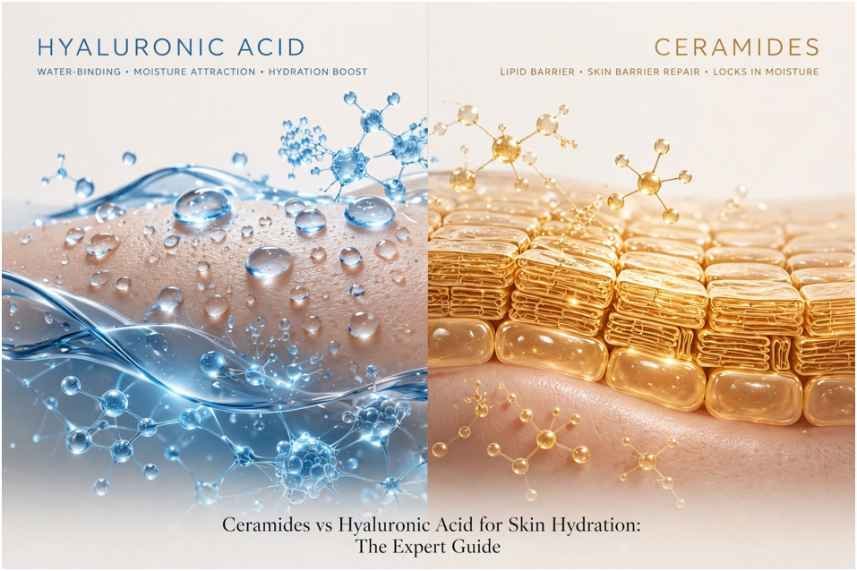
Deciding between ceramides vs hyaluronic acid for skin hydration is not an either-or decision. It comes down to understanding the critical difference between flooding your cells with water and reinforcing the physical gate that stops that water from vanishing.
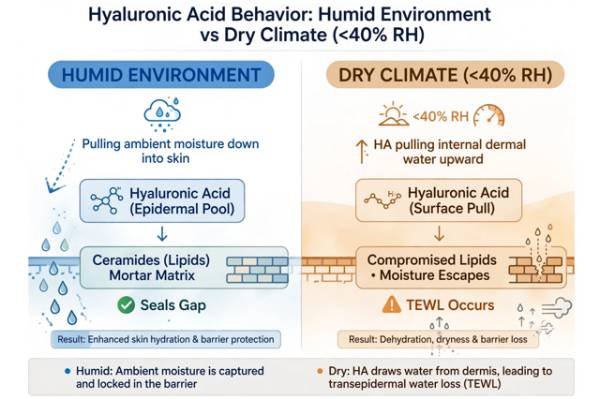
Hyaluronic acid supplies surface moisture, while ceramides provide the lipid structural matrix required to retain it. Without balanced lipids, humectants simply pull water outward into dry ambient air.
HUMID ENVIRONMENT DRY CLIMATE (<40% RH)
(HA pulls ambient moisture) (HA pulls internal dermal water)
│ ▲
▼ │
┌───────────────────┐ ┌───────────────────┐
│ Hyaluronic Acid │ │ Hyaluronic Acid │
│ (Epidermal Pool) │ │ (Surface Pull) │
└─────────┬─────────┘ └─────────▲─────────┘
│ │
┌─────────▼─────────┐ ┌─────────┴─────────┐
│ Ceramides (Lipids)│ ◄── [Seals Gap] ──► │ Compromised Lipids│ ◄── [TEWL Occurs]
│ Mortar Matrix │ │ Moisture Escapes │
└───────────────────┘ └───────────────────┘
The Biological Difference: Water Magnet vs. Structural Mortar
Healthy skin requires two distinct physiological mechanisms: water attraction and moisture retention. Skincare formulators frequently market both ingredients as simple hydrators, but their biochemical functions could not be more distinct.
Hyaluronic Acid: Why Molecular Weight Matters in Dry Air
Hyaluronic acid (HA) is an endogenous glycosaminoglycan. It operates as an exceptional humectant, capable of binding up to 1,000 times its molecular weight in water. When applied topically, it draws ambient moisture into the stratum corneum, creating instant dermal plumping and softening superficial fine lines.
The mechanism carries a major catch. As documented in clinical evaluations published by the Journal of Clinical and Aesthetic Dermatology, multi-weight hyaluronic acid formulations react dynamically to ambient humidity. When indoor heating or arid climates drop relative humidity below 40%, high-molecular-weight HA cannot harvest sufficient water from surrounding air.
It reverses direction. It pulls water out of your viable dermis toward the surface, where it rapidly evaporates. If you apply high-strength HA serums to dry skin without a seal, you speed up dehydration instead of fixing it.
Ceramides: Restoring the Epidermal Intercellular Matrix
Ceramides are physiological waxy lipids (sphingosides) that naturally comprise over 50% of the intercellular stratum corneum matrix. If skin cells are bricks, ceramides—alongside cholesterol and free fatty acids—form the mortar holding those bricks together.
According to research indexed in the National Center for Biotechnology Information, depleting your natural ceramide reserves creates microscopic fissures throughout the stratum corneum. These gaps trigger rapid trans-epidermal water loss (TEWL) and expose nerve endings to external irritants.
Ceramides do not draw ambient water from the room. They repair the protective sheath that keeps your biological water inside, preventing allergen penetration and restoring suppleness to compromised skin.
Key Performance Battle: Hydration Depth vs. Barrier Protection
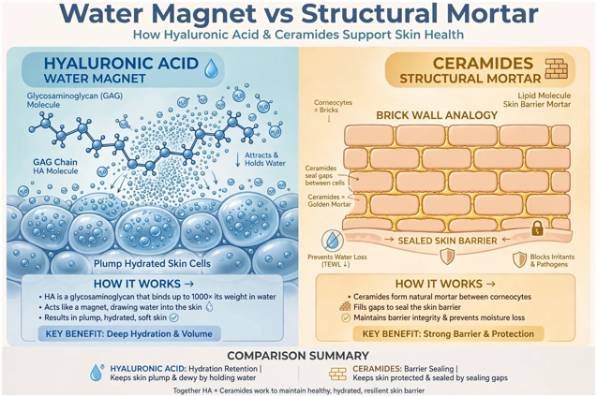
| Performance Parameter | Hyaluronic Acid | Ceramides |
| Primary Biochemical Class | Humectant (Glycosaminoglycan) | Emollient / Structural Barrier Lipid |
| Direct Mode of Action | Pulls and binds water molecules into tissue | Fills gaps between corneocytes to seal skin |
| Target Skin Concern | Dehydration, loss of volume, dullness | Barrier breakdown, flaking, stinging, eczema |
| Climate Dependency | High (demands ambient humidity or misting) | Low (functions consistently in dry climates) |
| Sensory Finish | Weightless, water-slip, instantly plumping | Rich, smooth, conditioning, protective |
When treating stubborn texture or working to fade post acne hyperpigmentation fast, stripping your skin barrier with harsh actives is your biggest risk. Hyaluronic acid gives you immediate visual bounce, but ceramides protect against the inflammation that triggers post-inflammatory erythema in the first place.
How I Layer Both to Stop Transepidermal Water Loss (TEWL)
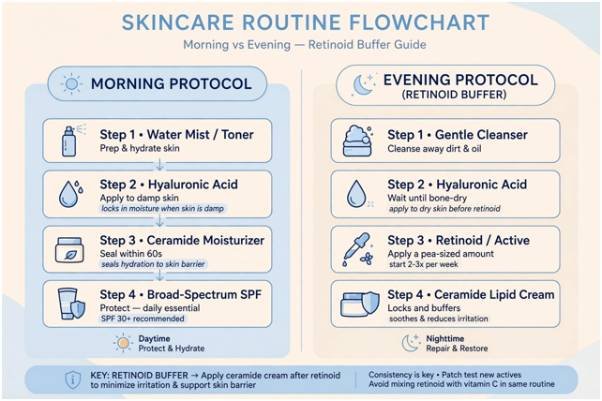
You do not need to choose one over the other. The most effective protocol utilizes both ingredients in sequence.
MORNING PROTOCOL EVENING PROTOCOL (RETINOID BUFFER)
┌──────────────────────┐ ┌──────────────────────┐
│ Water Mist / Toner │ │ Gentle Cleanser │
└──────────┬───────────┘ └──────────┬───────────┘
▼ ▼
┌──────────────────────┐ ┌──────────────────────┐
│ Hyaluronic Acid │ │ Hyaluronic Acid │
│ (Apply to damp skin) │ │ (Wait until bone-dry)│
└──────────┬───────────┘ └──────────┬───────────┘
▼ ▼
┌──────────────────────┐ ┌──────────────────────┐
│ Ceramide Moisturizer │ │ Retinoid / Active │
│ (Seal within 60s) │ └──────────┬───────────┘
└──────────┬───────────┘ ▼
▼ ┌──────────────────────┐
┌──────────────────────┐ │ Ceramide Lipid Cream │
│ Broad-Spectrum SPF │ │ (Locks and buffers) │
└──────────────────────┘ └──────────────────────┘
The 60-Second Moisture-Seal Protocol
Through continuous split-face testing in dry winter conditions, I found a standard approach for preventing humectant evaporation:
- Start with hydration: Cleanse your face thoroughly, but skip towel drying completely. Alternatively, saturate your skin with the best hydrating toner for sensitive dry skin.
- Apply HA to damp skin: Dispense three drops of hyaluronic acid directly onto the wet surface. Smooth it across your face; the formula will bind to the surface water instead of scavenging your skin’s internal reserves.
- Lock within 60 seconds: Never let hyaluronic acid air-dry until your skin feels tight. Apply your ceramide cream within one minute. The ceramide lipids create a hydrophobic seal over the water-saturated humectant, locking the hydration inside your stratum corneum.
How to Buffer Strong Retinoids and Direct Acids
Potent actives like tretinoin, encapsulated retinol, and glycolic acid strip away structural lipids over time. The American Academy of Dermatology recommends using barrier-support creams to buffer against chemical irritation and prevent contact dermatitis.
Avoid applying pure retinoids over damp hyaluronic acid. Water speeds up product penetration, which spikes tingling and chemical irritation.
Instead, apply your hyaluronic acid to damp skin, let it dry completely for five minutes, apply your retinoid, and cap the routine with a dense ceramide moisturizer. If your skin is easily sensitized, use the sandwich technique: apply your ceramide cream both before and after your retinoid.
Which One Does Your Skin Barrier Need Right Now?
Use this symptom-based diagnostic to choose where to focus your routine:
- Your primary symptom is tightness, dullness, and fine dehydration lines: Your skin lacks water. Add a dedicated hyaluronic acid serum to damp skin immediately before your daily moisturizer.
- Your primary symptom is stinging, redness, peeling, or windburn: Your barrier lipid layer has collapsed. Hyaluronic acid will likely sting on contact. Drop the humectants temporarily and focus exclusively on physiological ceramide creams formulated with a 3:1:1 ratio of ceramides, cholesterol, and fatty acids.
- Your skin is congested, oily, but feels tight underneath: You have dehydrated, oily skin. Skip thick, heavy ceramide balms and use a multi-molecular hyaluronic acid serum layered under a light, water-gel ceramide lotion.
Ditch the Rivalry, Keep the Moisture
Treating hydration as a duel between ceramides and hyaluronic acid misreads how human skin works. Hyaluronic acid is the drink of water; ceramides are the sealed bottle that keeps it from spilling across the floor.
If your skin feels dull, depleted, or chronically dry, stop relying solely on watery serums. Saturate your skin with humectants while it is wet, lock it down instantly with rich ceramides, and give your lipid barrier the structural defense it needs.
Frequently Asked Questions
1. Can I mix ceramides and hyaluronic acid together in the same routine?
Yes, using them together is ideal because hyaluronic acid adds water while ceramides lock it into the lipid barrier.
2. Which is better for acne-prone skin: ceramides or hyaluronic acid?
Hyaluronic acid is lighter and oil-free for instant hydration, though lightweight ceramide gels help repair barriers damaged by acne treatments.
3. Why does hyaluronic acid make my skin feel drier?
In low-humidity environments, hyaluronic acid pulls moisture out of deeper skin layers unless sealed immediately with an occlusive ceramide cream.
4. Do ceramides clog pores?
Pure ceramides are skin-identical lipids that do not clog pores, though heavy cream formulations containing thick waxes or oils might.
Leave a Reply