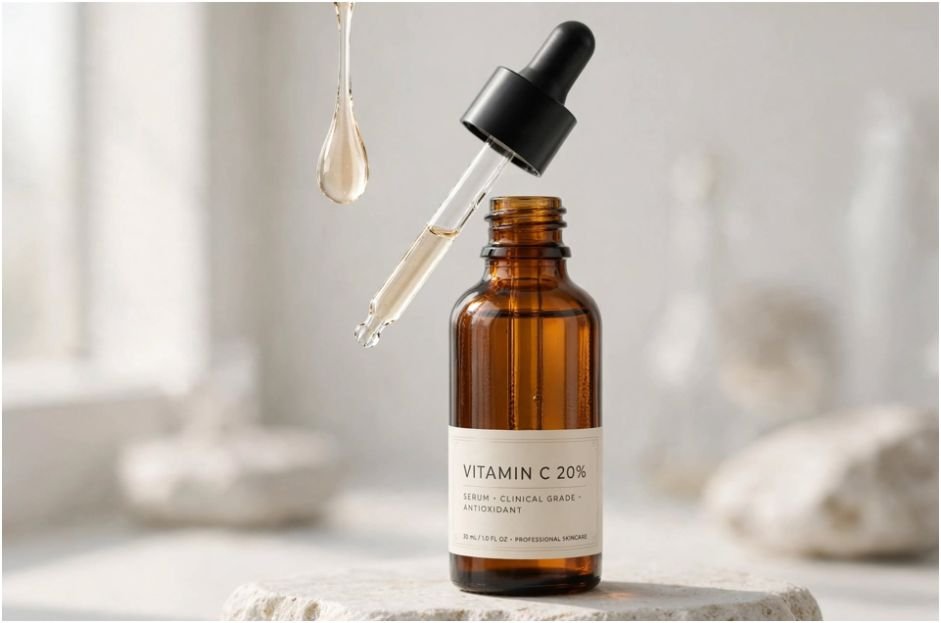
You bought an expensive amber dropper, patted a few drops into your skin this morning, and now you are staring into the mirror waiting for an overnight transformation. I have been there. If you want to know how long does it take for vitamin c serum to work, the quick answer is two distinct phases: surface radiance appears within 7 to 14 days, while structural pigment clearance and collagen production take 8 to 12 weeks of unbroken daily application.
Dermal biology moves at its own pace. Topical L-ascorbic acid must saturate your skin cells, neutralize free radicals, and wait out a full natural desquamation cycle before dark spots lift.
The Honest Clinical Timeline: What I Saw Week by Week
When I committed to clinical-grade L-ascorbic acid, I documented my skin changes across twelve consecutive weeks. Different skin concerns resolve at vastly different depths. Surface dehydration responds quickly; structural melanin clusters require patience.
| Phase | Visible Skin Response | Underlying Biological Mechanism | Expected Success Rate |
| Days 1–7 | Surface hydration, slight glow | Scavenging of reactive oxygen species (ROS) | ~90% of users |
| Weeks 2–4 | Brighter tone, refined pores | Stratum corneum moisture retention; reduced sebum oxidation | ~80% of users |
| Weeks 4–8 | Visibly lightened acne spots | Tyrosinase enzyme inhibition clears trapped melanin deposits | ~65% of users |
| Weeks 8–12+ | Firmer skin, softened lines | Proline and lysine hydroxylation stimulate collagen synthesis | ~50% of users |
Weeks 1 to 2: The Instant Surface Shift
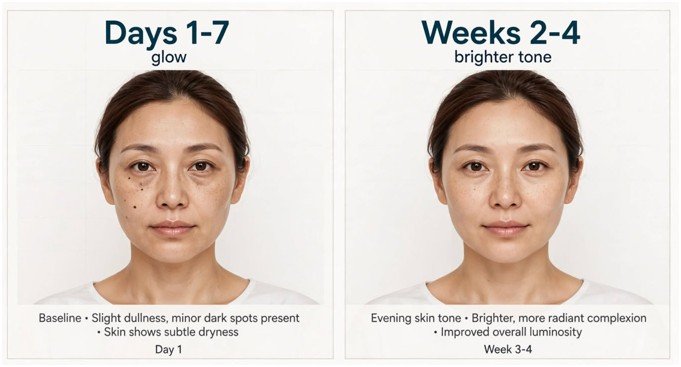
During the first ten days, the primary benefit is free radical defense. As outlined by researchers on NCBI, topical ascorbic acid rapidly neutralizes reactive oxygen species caused by urban pollution and UV exposure.
You will not see pigment disappear yet. Instead, my skin felt smoother, retained moisture better, and showed an unmistakable morning radiance caused by reduced sebum oxidation.
Weeks 4 to 8: Pigment Disruption and Fading
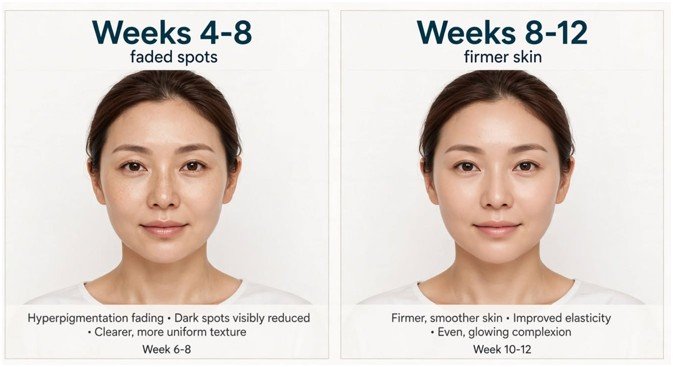
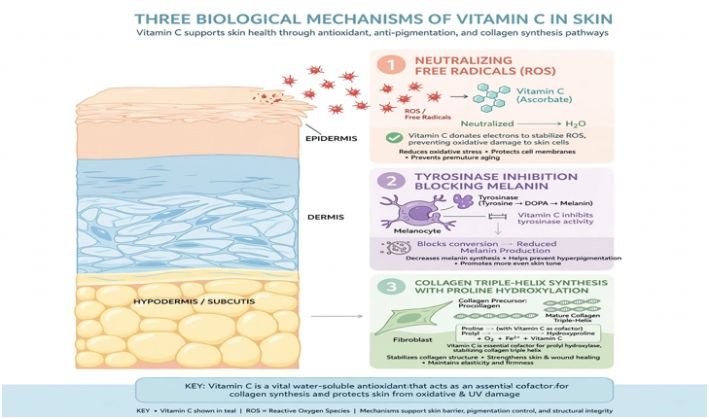
Around week five, deeper changes emerge. L-ascorbic acid directly inhibits tyrosinase, the enzyme responsible for melanin production. If your goal is to fade post acne hyperpigmentation fast, this is the window where stubborn post-inflammatory erythema (PIE) and sun spots begin breaking apart.
The peer-reviewed findings in the Journal of Clinical and Aesthetic Dermatology show that consistent tyrosinase blockade requires at least one full cellular turnover cycle (28 to 40 days) to transport fragmented pigment to the surface where it sloughs off naturally.
Weeks 8 to 12+: Deep Dermal Remodeling
Structural collagen synthesis takes the longest. Ascorbic acid acts as an essential cofactor for prolyl and lysyl hydroxylase, enzymes that stabilize the collagen triple-helix molecule. By week ten, I noticed softened expression lines around my eyes and a springier feel along my jawline.
Why Your Results Might Stall: Key Biological Bottlenecks
If you reach week six without noticeable improvement, one of three biological bottlenecks is likely stalling your progress.
| Bottleneck | Visible Clue | Immediate Fix |
| Oxidized Formulation | Serum turns orange, amber, or brown | Discard immediately; switch to airtight packaging |
| Sub-therapeutic pH | Stinging without results, or no absorption | Verify formulation pH rests between 2.5 and 3.5 |
| Skipping Daily SPF | Sun spots darken despite serum use | Apply broad-spectrum SPF 30+ every morning |
Formula Degradation and the Amber Drop
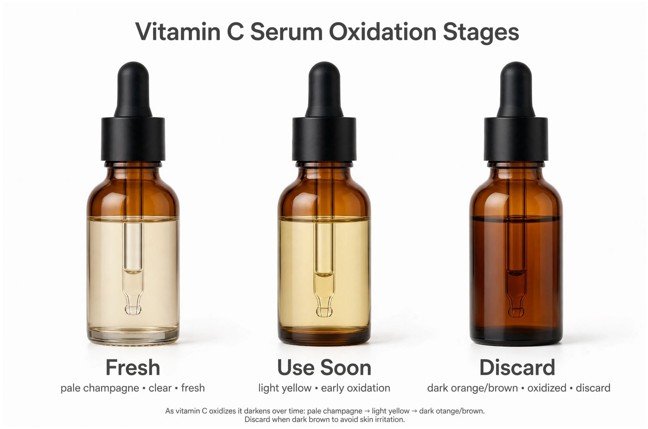
Pure L-ascorbic acid degrades upon contact with air, light, and warmth. Once oxidized, it transforms into dehydroascorbic acid and eventually erythrulose—the active ingredient in self-tanner.
If your serum shifts from pale champagne to dark orange, it will stain pores rather than brighten skin. Look for formulas balanced with Vitamin E and Ferulic acid, which stabilize the molecule and double its photoprotective value.
The Reservoir Depletion Rule
Clinical testing indicates that skin reaches maximum ascorbic acid saturation after three consecutive daily applications, creating a protective “reservoir” with a half-life of roughly 48 hours. If you skip three days in a row, your tissue levels drop below therapeutic thresholds. This breaks the tyrosinase inhibition cycle and forces your skin turnover clock to restart from day one.
Maximizing Absorption Speed Without Irritation

Applying your serum properly speeds up absorption without compromising your barrier. Apply 4 to 5 drops directly to cleansed, completely dry skin every morning. Water on the skin raises surface pH, hindering L-ascorbic acid from penetrating past the stratum corneum.
Many readers ask if layering other actives slows progress. As long as you introduce them carefully, you can safely evaluate whether can you use niacinamide with vitamin c together to accelerate barrier recovery while targeting dark spots simultaneously.
Always complete your morning routine with broad-spectrum sunscreen. As the American Academy of Dermatology emphasizes, UV exposure triggers fresh melanin synthesis and accelerates collagen degradation, instantly canceling out any progress your serum creates.
Frequently Asked Questions
1. Can I use vitamin C serum both morning and night to get faster results?
No, human skin reaches biological vitamin C saturation with once-daily application, so applying it twice daily wastes product and risks contact dermatitis.
2. Why is my skin purging after starting a new vitamin C serum?
Pure L-ascorbic acid has a low pH that causes mild irritation or peeling, but it does not accelerate cellular turnover like retinoids, meaning true inflammatory breakouts signal formula incompatibility rather than purging.
3. What should I do if my vitamin C turns light yellow?
A faint champagne tint indicates early exposure to air and is still safe to use, but store it in your refrigerator immediately to halt oxidation.
4. Does a higher percentage of vitamin C deliver faster results?
Formulas capped between 15% and 20% maximize cellular uptake; concentrations exceeding 20% do not improve absorption and substantially increase the risk of barrier damage.
Stop Staring in the Mirror: Commit to the 60-Day Mark
Do not ditch your serum after two weeks because your dark spots look the same. Surface radiance is your preview; deep pigment clearance is the main event. Keep your bottle tightly capped in the fridge, shield your barrier with daily sunscreen, and let cellular turnover complete its natural rhythm. Give it eight solid weeks of unwavering daily commitment, and your skin will reward your patience.
Leave a Reply