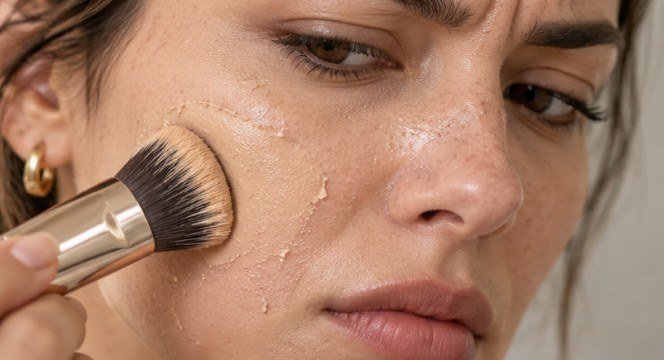
Those tiny grayish-white rolls that appear while blending foundation are not necessarily dry skin coming off your face. In many cases, they are layers of skincare and sunscreen physically gathering into small clumps as the surface film is disturbed.
So, why does sunscreen pill under makeup even when both products work perfectly well on their own? Usually, the problem is the interaction between the sunscreen, everything underneath it, the makeup above it, and the amount of rubbing involved.
The good news is that you rarely need to abandon sunscreen to fix the problem. You need to identify which layer is creating the unstable film.
What Sunscreen Pilling Actually Is
Pilling occurs when material sitting on the skin rolls or gathers into visible flakes or balls instead of remaining as a smooth, continuous layer.
A 2024 peer-reviewed study published in Skin Research and Technology examined skincare pilling in 528 women between ages 20 and 49. Researchers found that 217 participants, about 41%, experienced pilling during testing. Sunscreen was responsible for substantially more pilling events than foundation, and rubbing products in circular or linear motions produced some of the highest rates of pilling.
That finding matters because it suggests pilling is not simply a sign that your skin is “too dry” or that your sunscreen is defective. Skin characteristics, the products underneath SPF and your application technique can all contribute.
Why Does Sunscreen Pill Under Makeup in the First Place?
Your Sunscreen Has Not Finished Setting
Sunscreens contain combinations of UV filters, emulsifiers, thickeners, powders, emollients and film-forming ingredients. After application, water or other volatile components may need time to evaporate so the formula can form an even layer.
Applying foundation while that layer is still mobile creates additional friction. Instead of sitting over the sunscreen, the makeup applicator may begin moving portions of the SPF film around.
Johns Hopkins Medicine recommends putting sunscreen on before makeup and notes that makeup alone generally does not provide enough sunscreen coverage. Its dermatology guidance also emphasizes finding a layering routine that works with the formulas you use.
There Are Simply Too Many Layers
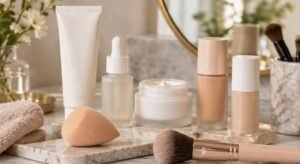
A morning routine might include toner, antioxidant serum, hydrating serum, moisturizer, face oil, sunscreen, primer and foundation for mature skin.
Every additional layer introduces more water, oil, powder, polymer or film-forming material onto the same small area of skin.
The American Academy of Dermatology recommends a simpler sequence: cleanse, apply treatments, use moisturizer and/or sunscreen, then apply makeup. It also cautions that using excessive skincare products can create other skin problems.
If removing one optional layer suddenly eliminates pilling, the sunscreen may never have been the real problem.
The Formulas Are Not Compatible
You will often hear that water-based makeup should only be paired with water-based sunscreen or that silicone-containing products must be paired together.
That rule is too simplistic.
Finished cosmetics are complex mixtures, and two products can contain some of the same ingredients yet behave very differently. Film-formers, thickeners, powders and the proportions of different ingredients all affect how a formula dries and responds to rubbing.
The 2024 pilling study also found that different base products produced different results on the same people, supporting the idea that the complete formulation—not one ingredient—is important. Instead of judging compatibility from the first five ingredients, test the actual combination.
You Are Rubbing Instead of Pressing
Technique is an underestimated cause. Once sunscreen has formed a film, repeatedly dragging a brush, fingers or a sponge across the surface can mechanically disrupt it. That is especially noticeable around the nose, chin, eyebrows and hairline, where people tend to blend repeatedly.
Interestingly, the clinical study found that foundation sometimes reduced visible sunscreen pilling rather than making it worse. That means makeup itself is not automatically the culprit; how it is placed over the sunscreen may be more important.
Try This Three-Day Pilling Test
Instead of replacing your entire routine, isolate the problem.
| Test Day | Morning Routine | What the Result Tells You |
| Day 1 | Moisturizer + sunscreen only | Shows whether SPF pills without makeup |
| Day 2 | Moisturizer + sunscreen + foundation | Tests SPF-foundation compatibility |
| Day 3 | Full skincare + sunscreen + foundation | Reveals whether an earlier skincare layer triggers the problem |
Use the same amount of sunscreen each day and keep the application method consistent.
If Day 1 pills, investigate the moisturizer-sunscreen combination. If Day 1 is smooth but Day 2 pills, foundation technique or compatibility becomes more likely. If only Day 3 fails, one of your additional skincare steps probably needs to be removed, reduced or replaced.
A Better Morning Layering Method

Start with clean skin and apply treatment products sparingly. Follow with moisturizer if your skin needs it, rather than automatically using a thick cream underneath every SPF.
Allow each wet layer roughly 30 to 60 seconds to settle before continuing. After sunscreen, waiting several minutes before makeup can make application easier because the surface has had time to become less mobile.
Do not solve pilling by dramatically reducing your sunscreen amount. That trades a cosmetic problem for inadequate UV protection.
The U.S. Food and Drug Administration advises applying sunscreen generously and applying it about 15 minutes before sun exposure. It also recommends reapplication at least every two hours, with more frequent application after swimming or sweating.
For makeup, use the least aggressive technique possible. Place foundation onto the face and press or lightly bounce it into place instead of repeatedly polishing the surface.
Do Not Rely on Makeup SPF to Avoid Pilling
One tempting solution is eliminating facial sunscreen and relying entirely on SPF foundation.
That usually creates another problem: people rarely use enough foundation to obtain the level of protection measured during SPF testing.
The Skin Cancer Foundation recommends applying regular sunscreen beneath makeup rather than treating SPF cosmetics as a substitute for a proper sunscreen layer.
Harvard Health likewise recommends making sunscreen part of the morning skincare routine and using at least SPF 30 for facial protection.
For U.S. consumers, that means the priority should remain adequate broad-spectrum protection first and cosmetic compatibility second.
When Waiting Longer Will Not Fix the Problem

Waiting helps when you are simply layering products too quickly, but it cannot rescue every incompatible combination.
If the same moisturizer, sunscreen and foundation pill after several careful trials—with thin skincare layers, adequate drying time and minimal rubbing—stop forcing the combination.
Changing one product is usually more effective than waiting 15 minutes between every cosmetic step.
Also distinguish true pilling from dry-skin flaking. If flakes exist before sunscreen is applied, especially alongside tightness, redness or irritation, the issue may be the skin surface itself rather than product compatibility.
Frequently Asked Questions
1. Why does my sunscreen only pill when I apply foundation?
Foundation application adds friction. If your SPF has not fully set or the two formulas layer poorly, brushing or rubbing foundation over it can disturb the sunscreen film.
2. Should I wait before applying makeup over sunscreen?
Yes. Allowing sunscreen a few minutes to settle can reduce movement and friction during makeup application. Remember that the FDA’s separate 15-minute recommendation refers to timing before sun exposure.
3. Does silicone in sunscreen cause pilling?
Not automatically. Silicone-containing products can pill, but so can formulas without them. Compatibility depends on the complete sunscreen, skincare and makeup formulations rather than one ingredient alone.
4. Can I use less sunscreen to stop pilling?
That is not the best fix. Using too little sunscreen may reduce the protection you receive. Simplify your skincare or change an incompatible layer instead.
The Smoothest Fix Is Usually the Simplest One
The frustrating part of pilling is that it looks like a sunscreen failure when it is often a layering failure. Research suggests that skin condition, underlying products and especially rubbing technique can all influence whether those little rolls appear.
Start by simplifying your routine rather than replacing everything. Test moisturizer plus sunscreen first, add makeup second, then restore optional skincare one layer at a time. Give SPF a chance to set and press makeup onto the skin instead of repeatedly rubbing it. A smooth base should never require sacrificing the sunscreen layer that is there to protect your skin.
Leave a Reply