Dry makeup usually starts going wrong before foundation touches the face. When the skin’s outer barrier loses water, its surface becomes rougher and less flexible, so pigment catches on flakes instead of sitting evenly. A successful makeup routine for dry skin is therefore less about finding a “miracle” foundation and more about controlling hydration, friction, and product buildup.
The American Academy of Dermatology recommends moisturizing damp skin and notes that creams and ointments generally hold more moisture than lotions. Moisturizer science explains why: humectants attract water, emollients smooth the skin surface, and occlusives reduce water loss.
Why Dry Skin Makes Makeup Look Patchy
Dry skin is not simply skin that needs more oil. The stratum corneum, the outermost skin layer, needs enough water and an intact lipid barrier to stay flexible and shed normally. When water drops, dead surface cells can accumulate unevenly, creating the rough patches foundation tends to exaggerate.
Low humidity can make this worse. In the U.S., winter heating, dry Southwestern climates, and constant indoor air conditioning can all contribute to moisture loss. Harvard Health also notes that cold, dry winter air and indoor conditions can worsen dry skin.
The practical goal is to apply makeup to skin that feels comfortable and supple, not freshly scrubbed, tight, or buried under slippery skincare.
Step 1: Hydrate Without Overloading the Skin
Begin with a gentle cleanser or simple rinse. If your face feels tight immediately afterward, the cleansing step may already be too drying.
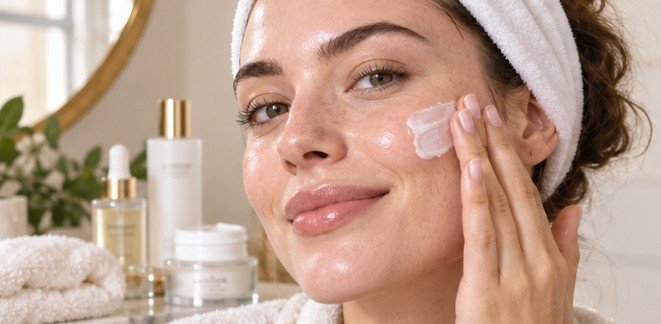
A hydrating toner or essence is optional. A serum with glycerin or hyaluronic acid can add water-binding support, but it should not replace moisturizer. Follow with a fragrance-free cream containing ingredients such as ceramides, glycerin, dimethicone, petrolatum, or hyaluronic acid. Dermatology guidance specifically identifies several of these ingredients as useful options for dry skin.
Apply moisturizer while the skin is slightly damp, then let it settle. More layers are not automatically better. Multiple serums, facial oil, heavy cream, sunscreen, primer, and foundation can pill or slide. If makeup rolls into tiny crumbs, simplify the prep before changing foundation.
Step 2: Keep Sunscreen in the Routine
Dry skin still needs sun protection. Dermatologists recommend broad-spectrum SPF 30 or higher, and the Skin Cancer Foundation cautions that cosmetic products may not provide sufficient UVA protection on their own.
Choose a facial sunscreen with a moisturizing or cream-like finish if matte formulas leave your skin tight. Let it form an even layer before makeup.
If sunscreen and foundation repeatedly pill, test them separately. The problem may be incompatible or overly thick layers rather than dry skin itself.
Step 3: Treat Primer as Optional
Primer should solve a problem, not exist simply because a routine says it must.
If moisturizer and sunscreen already leave a smooth surface, skip it. If makeup tends to catch around the cheeks, mouth, or between the brows, use a thin layer of hydrating or luminous primer only there.
Strongly mattifying pore primers can make flaky areas look more obvious, even if they blur pores elsewhere.
Step 4: Use Thin, Flexible Base Layers
Liquid, serum, skin-tint, and creamy foundations with natural, satin, or dewy finishes are often easier to wear on dry skin than very matte formulas.
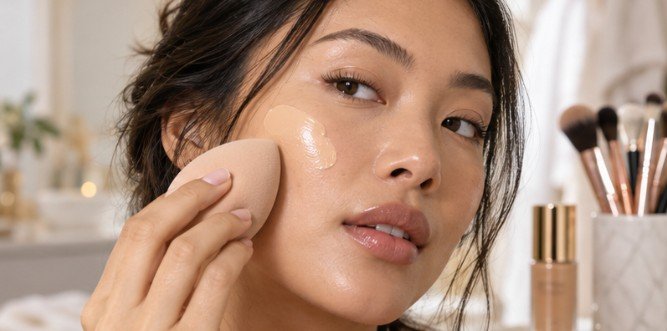
Start with less product than usual. Blend from the center of the face outward. A damp sponge can press foundation ( choose water-based or silicone- based foundation) in with little friction, while a soft brush works well when used with a stippling motion instead of repeated buffing.
Clean fingers can also work for cream products. The real problem is friction. Rubbing or dragging over the same area can lift flakes regardless of the tool.
After each layer, stop and check the skin. If coverage already looks even, do not add more. Use concealer only where needed, especially under the eyes, where heavy product can emphasize dehydration lines.
Step 5: Prefer Cream Color, Then Powder With Purpose
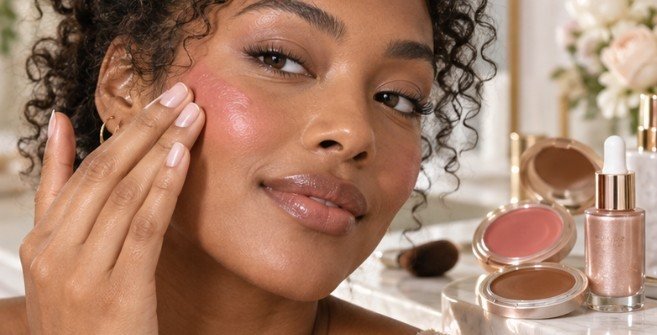
Cream blush, bronzer, and liquid highlighter usually blend more easily over a hydrated base because they do not add another dry layer.
Powder is not forbidden; it simply needs a job.
| What you see | Likely issue | Better adjustment |
| Foundation catches on flakes | Skin is dry or over-exfoliated | Moisturize and press on less base |
| Makeup slides around the nose | Too many prep layers | Reduce skincare and foundation amounts |
| Concealer looks crepey | Too much concealer or powder | Use thinner layers and targeted setting |
| Face looks flat and tight | Too much finishing powder | Powder selectively and use a light mist |
Set only areas that crease, transfer, or become shiny, such as the sides of the nose, under the eyes, or center of the forehead. Avoid coating the whole face unless you truly need it.
A light hydrating setting spray can soften the look of powder and help the layers appear more seamless.
The Two-Minute Dry-Skin Check

Before finishing, inspect four areas: beside the nose, between the brows, around the mouth, and under the eyes. Texture often appears there first.
If you see flakes, do not add more foundation. Press lightly with a damp sponge. If necessary, place the tiniest amount of moisturizer on the sponge and tap around the patch.
If the skin is cracking, burning, persistently itchy, or developing a rash, makeup technique is no longer the main issue. The American Academy of Dermatology advises seeking professional care when significant dryness or irritation does not improve with appropriate self-care.
Read Labels, Not Just Beauty Claims
For sensitive dry skin, product marketing can be misleading. In the U.S., the FDA says the term “hypoallergenic” does not guarantee that a cosmetic cannot trigger a reaction. It also notes that some fragrance ingredients may cause allergic reactions or sensitivities in certain people.
That makes ingredient lists useful, especially if your skin reacts easily. Introduce one new complexion product at a time so it is easier to identify what caused irritation.
Frequently Asked Questions
1. Should I exfoliate before makeup if my skin is flaky?
Not routinely. If skin is irritated or visibly peeling, aggressive exfoliation can worsen dryness. Moisturize first and exfoliate only when your skin tolerates it.
2. Is powder bad for dry skin?
No. It works best in small amounts on areas that crease, transfer, or become shiny rather than across the entire face.
3. What foundation finish works best for dry skin?
Natural, satin, and dewy finishes are usually the most forgiving. Hydrating liquid, serum, and cream formulas tend to move with the skin more comfortably.
4. How do I stop a makeup routine for dry skin from looking cakey?
Use fewer prep layers, let skincare settle, apply foundation thinly, conceal only where needed, and set strategically instead of powdering the whole face.
Final Takeaway
The biggest mistake with dry-skin makeup is trying to cover texture instead of improving the surface underneath it. Better results come from restoring moisture, reducing friction, and using less product at every stage. Start with a cream moisturizer on slightly damp skin, protect with sunscreen, choose flexible complexion formulas, and reserve powder for areas that genuinely need it.
If flakes appear, simplify rather than add coverage. A good makeup routine for dry skin should leave the face looking comfortable, mobile, and naturally luminous—not like several products competing on top of one another.
Leave a Reply