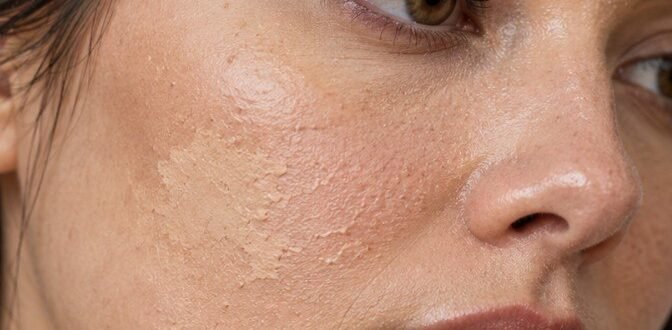
Foundation rarely falls apart for no reason. If it looks smooth in the morning but turns spotty around the nose, breaks into tiny islands on the cheeks, or disappears from the T-zone by lunch, something has disrupted the makeup film sitting on your skin.
If you keep asking why does my foundation separate on my face, the answer is usually one of five things: excess oil, dry or irritated skin, too much skincare underneath, unstable layering, or simply too much foundation. Finding the failure point is more useful than immediately switching formulas.
What Foundation Separation Actually Looks Like
Separation is more than normal fading. Foundation may split into visible dots, collect around pores, crack over dry areas, or leave bare patches beside heavier pigment.
Facial skin is not uniform. Research on skin-surface lipids shows that sebum contributes heavily to the oily film on areas rich in sebaceous glands, while epidermal lipids help the skin barrier control water loss.
Why Foundation Breaks Apart
Excess oil is loosening the makeup film
If separation starts around the nose, forehead, or chin after several hours, sebum is a likely cause. Oil can mix with the makeup layer, encouraging pigment to migrate or gather around pores.
Do not respond by stripping the skin. The American Academy of Dermatology recommends gentle cleansing for oily skin and notes that moisturizer can still be important.
Dryness is creating an uneven surface
Dry or flaky skin gives foundation a rough surface to cross. Pigment catches on lifted skin cells while nearby areas look thin or bare.
The outer skin barrier helps control transepidermal water loss. Research shows that barrier condition, body site, and environment can affect that water loss. This helps explain why makeup can behave differently during dry U.S. winters, after over-exfoliation, or in heavily heated spaces.
Too much skincare is sitting underneath
A rich moisturizer, oil, sunscreen, primer, and foundation can create several overlapping films. If the surface still feels slick or tacky, foundation may move instead of setting.
The American Academy of Dermatology recommends this order: cleanse, treatment if needed, moisturizer and/or sunscreen, then makeup. It also warns that too many products can irritate skin.
You do not need a rigid three- or five-minute timer. Apply foundation for mature skin when the previous layer feels settled rather than wet or mobile.
The layers do not work well together
The rule “water with water, silicone with silicone” is only a shortcut. Many skincare products are emulsions containing water, oils, silicones, and other ingredients in one formula. Harvard Health notes that moisturizers are often oil-in-water emulsions and may contain silicones such as dimethicone.
A better test is practical: if your base separates only when a certain primer or moisturizer is underneath, that pairing is the more useful suspect.
You are applying too much foundation
A thick layer is more likely to crease, crack, or shift as oil, sweat, and facial movement build through the day. Adding wet foundation over makeup that has already begun setting can also create uneven thickness. Start thin. Add a small second layer only where you need more coverage.
Use This Split-Face Test Before Changing Products

Troubleshoot one variable at a time. On clean skin, use simple skincare and sunscreen. The American Academy of Dermatology advises applying sunscreen beneath makeup and using broad-spectrum SPF 30 or higher for outdoor exposure.
Apply primer to only one side of your face and leave the other side primer-free. Use the same thin amount of foundation on both sides. Check the result after about 30 minutes and again several hours later.
If only the primed side breaks apart, the primer-foundation combination may be contributing. If both sides separate mainly through the T-zone, oil or sweat is more likely. If both sides crack on the cheeks or around the mouth, dryness or irritation deserves attention first.
Repeat on another day while changing only one factor. This simple A/B test is more informative than replacing several products at once.
Read the Pattern Before You Fix It
| What you see | Likely cause | First adjustment |
| Shiny gaps on nose or forehead | Oil, sweat, heavy prep | Blot; use thinner layers |
| Pigment clinging to flakes | Dryness or irritation | Moisturize; reduce harsh exfoliation |
| Immediate rolling or lifting | Too many layers or poor pairing | Simplify prep |
| Cracks near smile lines | Excess foundation or powder | Use less product |
| Smooth first, broken hours later | Oil, humidity, normal wear | Blot before touching up |
How to Stop Foundation Separation
Start with a calm, even skin surface. Cleanse gently, moisturize according to your skin type, and keep sunscreen in the routine. Combination skin may need lighter hydration through the T-zone and more support on drier areas.
Next, use less makeup. Apply foundation in a thin layer and blend outward. Add coverage only where needed instead of building the entire face equally.
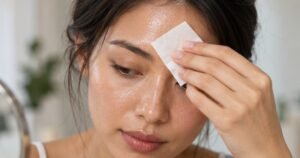
During the day, blot before adding anything. Press a clean tissue over oil or sweat, then press the remaining makeup back into place. Wiping removes the film, while adding more wet foundation directly over sebum often makes texture worse.
Climate matters too. A routine that works in a dry Colorado winter may feel too rich in a humid Florida summer. Humidity, heating, air-conditioning, and sweat can all change wear time.
When It Is More Than a Makeup Problem
Persistent redness, stinging, itching, scaling, or tenderness suggests that the skin itself may need attention. Cleveland Clinic dermatologists include dryness, rough patches, irritation, flaking, and stinging among possible signs of a damaged skin barrier.
If those symptoms continue, reduce irritating skincare and consider seeing a board-certified dermatologist. Makeup can highlight eczema, contact dermatitis, or treatment irritation without being the true cause.
The FDA regulates foundation as a cosmetic in the United States, while makeup with SPF claims is regulated as both a cosmetic and a drug.
Frequently Asked Questions
1. Why does foundation separate around my nose?
The nose is oil-prone and textured, so makeup often loses grip there first. Use lighter prep, less foundation, and blot before touching up.
2. Can dry skin make foundation separate?
Yes. Flakes interrupt an even makeup film, causing pigment to cling in some spots and disappear in others.
3. Why does my foundation separate on my face even with primer?
Primer cannot fix excess oil, dryness, heavy skincare, or a poor pairing. Test one side without primer to see whether it actually improves wear.
4. Should I skip sunscreen if foundation separates over it?
No. Keep sunscreen and adjust the makeup routine instead. Let sunscreen settle, then apply a thinner foundation layer.
The Takeaway
Foundation separation is usually a surface problem before it is a foundation problem. The best clue is where and when breakup begins: immediate rolling suggests layering trouble, midday T-zone gaps point toward oil, and flaky patches point toward dryness or irritation.
Change one variable at a time, let skincare settle, and use less foundation than you think you need. Once you identify the failure point, the fix becomes far more predictable.
Leave a Reply