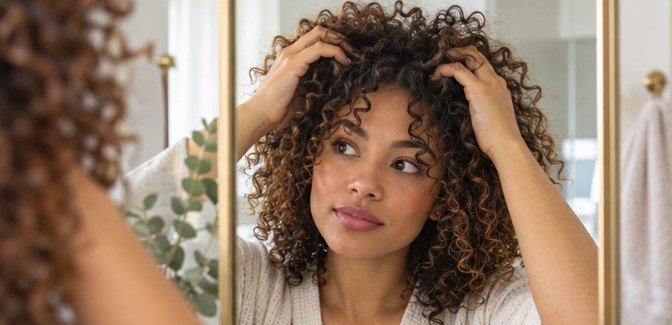
Most second-day curls do not need another wash—or another palmful of styling cream. They usually need less: a little water, targeted reshaping, and enough drying time to let the curl pattern settle again.
If you are wondering how to refresh curly hair without washing, treat only what changed overnight. Flat roots need lift, fuzzy sections need smoothing, and crushed curls need moisture. Re-soaking the whole head can add drying time and leave curls limp.
The American Academy of Dermatology notes that curly and coily hair is more prone to dryness and breakage than straighter textures, which makes gentle between-wash care especially useful.
Why a Curly-Hair Refresh Works
Wash day leaves behind curl shape plus a thin film of conditioner and styling product. The next day, a small amount of water can soften that film and make many stylers workable again.
More water is not automatically better. Hair fibers absorb water and swell. A hair-cosmetics review available through the National Library of Medicine explains that repeated water exposure, grooming, chemical processing, and environmental stress can contribute to progressive hair-shaft weathering.
The practical rule is simple: use the least moisture that restores the curl’s shape.
Use the 30-Second Curl Check
Before reaching for a spray bottle, check your roots, mid-lengths, and ends separately.
If the roots are flat but the curl clumps still look good, lift only the roots. If the mid-lengths are frizzy, mist that area. If two curls are crushed, reset those two instead of refreshing your entire head.
| What you see | Best refresh move | Avoid |
| Flat roots | Finger-fluff at the scalp | Saturating roots |
| Surface frizz | Smooth with damp palms | Dry brushing |
| Crushed curl clumps | Mist, scrunch, reshape | Heavy cream everywhere |
| Dry ends | Diluted leave-in on ends | Coating full strands |
| Itchy or flaky scalp | Cleanse the scalp | Adding more styler |
This quick assessment prevents one of the biggest refresh mistakes: treating every curl as though it has the same problem.
How to Refresh Curly Hair Without Washing Step by Step
1. Start With Dry Hair
Use clean fingers to lift your roots and separate any flattened clumps. Avoid aggressively raking through dry curls.
The American Academy of Dermatology advises against brushing curly hair while it is dry because doing so can increase breakage and frizz. For most morning refreshes, your fingers are enough.
2. Smooth Before Adding Water
For light halo frizz, first press your palms gently over the outside of your hair or finger-coil a fuzzy curl back into its natural direction.
Not every flyaway means your hair needs more hydration. Sleep friction, a sweatshirt hood, a car headrest, or dry indoor heating can disturb the surface of curls without requiring a complete re-wet.
3. Mist, Do Not Soak
Use a fine-mist spray bottle or wet your hands and lightly glide them over the sections that need reshaping. Your hair should feel damp rather than saturated.
Scrunch upward, then wait briefly before adding anything else. Water may be enough to soften and reactivate some of the styling product left from wash day.
This is especially useful with gels and other stylers that regain flexibility after being lightly dampened.
4. Spot-Treat With Styling Product
If water alone does not restore definition, emulsify a pea-size or smaller amount of your usual gel or leave-in conditioner with water between your palms.
Apply it only where definition, moisture, or hold is missing.
Fine curls often collapse under repeated layers of cream, while coarse or more porous curls may tolerate additional conditioning. The correct amount is the smallest quantity that improves the section without leaving it sticky, waxy, greasy, or noticeably heavier.
5. Reset Misshapen Curls Individually
For stretched pieces around your face or underneath your hair, dampen the curl, smooth it gently between two fingers, and loosely wrap it around a finger in the direction it naturally curls.
Release without pulling it straight.
Targeting individual curls may sound slower, but it is usually much faster than wetting and restyling sections that already look good.
6. Let the New Shape Set
Air-dry if you have time. If not, use a diffuser with relatively low heat and gentle airflow, keeping it moving instead of concentrating heat on one spot.
Excessive heat can contribute to hair-shaft damage, so turning the dryer hotter is not necessarily a better shortcut. ColumbiaDoctors recommends avoiding excessive heat as part of protecting hair from preventable damage.
Try not to touch curls repeatedly while they are drying. Constant scrunching, separating, and rearranging can break apart the clumps you just recreated.
How Much Water Is Too Much?
Stop adding moisture once the curl becomes flexible enough to reshape.

If water is dripping onto your shoulders, your roots are soaked even though they were not part of the problem, or your entire head has darkened from saturation, you have moved from refreshing into partial re-washing.
That is not necessarily harmful, but it defeats the purpose of a quick refresh. More water also means considerably more drying time and another opportunity to disturb your curl pattern.
When Refreshing Is the Wrong Move
A curl refresh is a styling method. It is not a replacement for scalp cleansing.
Cleveland Clinic dermatologists explain that washing frequency should reflect hair texture, scalp oiliness, age, and symptoms. Curly hair may generally tolerate longer intervals between washes than fine, oily hair, but itching, redness, flakes, and dandruff can indicate that the scalp needs attention.
Mayo Clinic similarly notes that styling products can accumulate on the scalp and contribute to oiliness and dandruff.
ColumbiaDoctors advises washing when the scalp becomes itchy, explaining that oil accumulation can contribute to scalp problems in some people.
If your scalp feels greasy, smells unusual, remains itchy, or shows noticeable flakes, washing is usually more useful than spraying another layer of water and styling product onto the hair.
Make Tomorrow’s Refresh Easier Tonight
The easiest morning refresh often starts before bed.
Loosely gathering longer curls into a high pineapple can reduce crushing while you sleep. A satin or silk bonnet or pillowcase may also reduce friction against the hair surface. The American Academy of Dermatology specifically recommends nighttime strategies such as loose pineappling and satin or silk materials for preserving curly hairstyles.
The goal is not to preserve every curl perfectly. It is to reduce the number of sections that need repair the following morning.
If refreshing routinely takes longer than your original styling routine, consider whether your nighttime protection, product quantity, haircut shape, or wash-day hold needs adjusting.
Three Mistakes That Ruin a Refresh

The first is automatically adding more cream. Extra conditioning can help genuinely dry ends, but it can also weaken hold and flatten finer curls.
The second is brushing through dry curls simply to make them appear neater. A few flyaways can quickly turn into widespread frizz once established curl clumps are pulled apart.
The third is repeatedly refreshing through obvious buildup. Between-wash styling should extend a clean hairstyle, not indefinitely postpone cleansing.
Frequently Asked Questions
1. Can I refresh curls with only water?
Yes. Start with water because it may reactivate your existing styling products. Add diluted gel or leave-in only if individual sections still need more hold or moisture.
2. How often can I refresh curly hair?
Refresh as needed between washes, but cleanse if your scalp becomes excessively oily, itchy, flaky, irritated, or noticeably coated with styling-product buildup.
3. Why does my hair get frizzier after refreshing?
You may be using too much water, touching curls repeatedly while they dry, or layering excessive product. Try less moisture, smaller amounts of styler, and less manipulation.
4. Should I refresh curly hair every morning?
No. If your curls still look defined, leave them alone. Refreshing only damaged sections reduces product buildup, physical manipulation, and drying time.
A Better Refresh Is Usually a Smaller One
Learning how to refresh curly hair without washing is less about recreating wash day and more about making precise corrections. Start dry, identify the sections that actually changed, mist lightly, add product only where water is not enough, and let the curls set before touching them again.
That restraint is what makes the technique effective. You preserve more of the original curl pattern, avoid unnecessary product buildup, and spend less time fixing sections that were never broken. The best refresh is rarely the wettest or most product-heavy one. It is the one that changes only what genuinely needs changing.
Leave a Reply