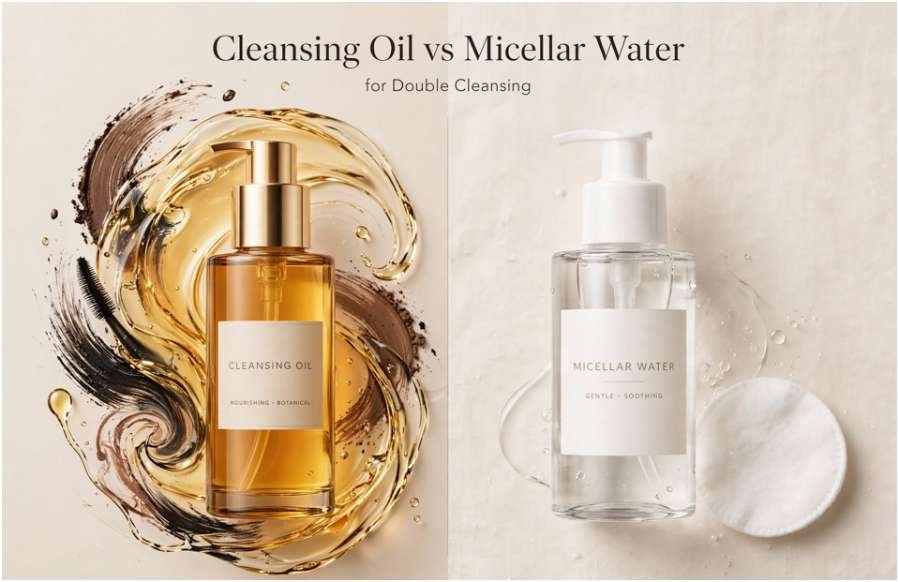
If you wear mineral sunscreen, long-wear foundation, or silicone-based primer, your evening wash determines your barrier health. Choosing cleansing oil vs micellar water for double cleansing comes down to basic chemistry: do you want to dissolve oil-based debris with matching lipids, or wipe it away using surface-active agents?
I spent years alternating between both formulas across different skin conditions behind the treatment room sink. While both products remove surface grime, they interact with the stratum corneum in radically different ways.
The Chemistry of the First Cleanse: Lipids vs. Surfactants
A true double cleanse targets two distinct categories of impurities. The first step targets oil-soluble debris like sebum plugs, silicones, and organic UV filters. The second step removes water-soluble debris like airborne pollutants, sweat, and cellular shed.
How Cleansing Oils Solubilize Stubborn Hydrophobic Binders
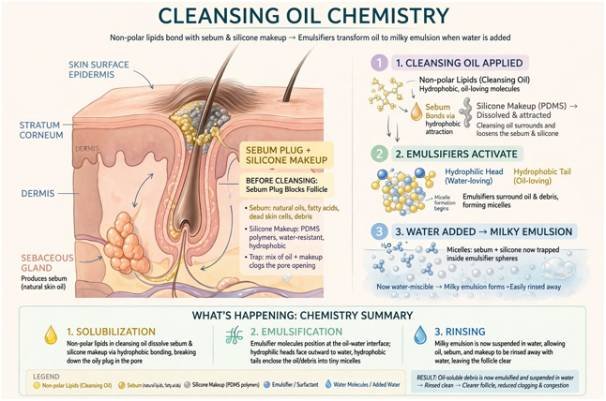
Cleansing oils rely on non-polar solvents to break down non-polar cosmetic ingredients. Because non-polar substances dissolve in other non-polar matrices, the carrier lipids bond instantly with oxidized sebum inside follicular openings.
High-grade cleansing oils contain emulsifiers like polysorbate 85 or PEG-20 glyceryl triisostearate. Once you introduce water, these oils flash into a white emulsion that rinses away cleanly without stripping intercellular lipids, as noted in barrier function studies indexed on the National Center for Biotechnology Information (NCBI).
How Micellar Water Suspends Surface Residue
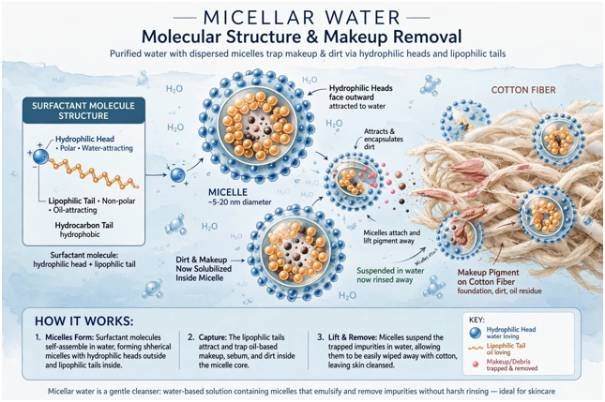
Micellar water is fundamentally purified water containing dispersed microscopic surfactant clusters called micelles. These molecules have hydrophilic heads and lipophilic tails. The tails attract dirt and pigment, while the heads remain dissolved in water.
When swept over the face on a cotton round, the cotton fibers attract the polar heads, trapping cosmetic debris against the pad. However, micellar water lacks the fluid volume needed to sink into congested pores and liquefy compacted sebum.
Face-to-Face Comparison: Performance, Friction, and Pore Clearing
| Factor | Cleansing Oil | Micellar Water |
| Primary Mechanism | Plant or synthetic lipids dissolve makeup and sebum | Surface surfactants trap debris on a pad |
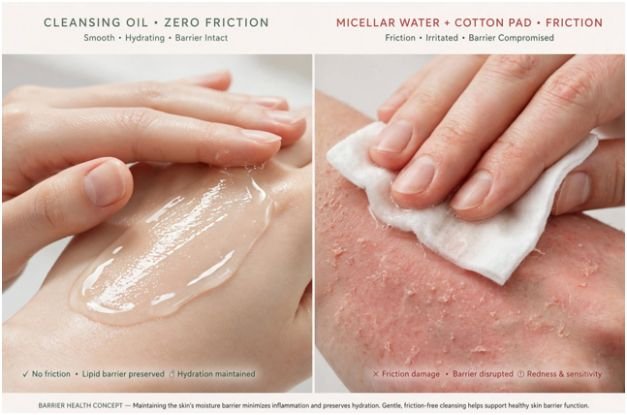
| Mechanical Friction | None; glides over skin using only bare hands | Moderate to high; requires cotton pad wiping |
| Waterproof SPF Removal | Complete melt within 45 seconds of massage | Incomplete; leaves trace residue in crevices |
| Pore Congestion & Plugs | Penetrates follicular openings to loosen sebum | Surface-level action only; cannot clear deep plugs |
| Rinsing Requirement | Obligatory; emulsifies into milk and washes off | Strongly recommended to prevent surfactant buildup |
| Best Suited For | Daily sunscreen wearers, full makeup, normal to dry skin | Active eye irritation, lash extensions, quick travel fixes |
What Happened When I Tested Both Under a UV Camera
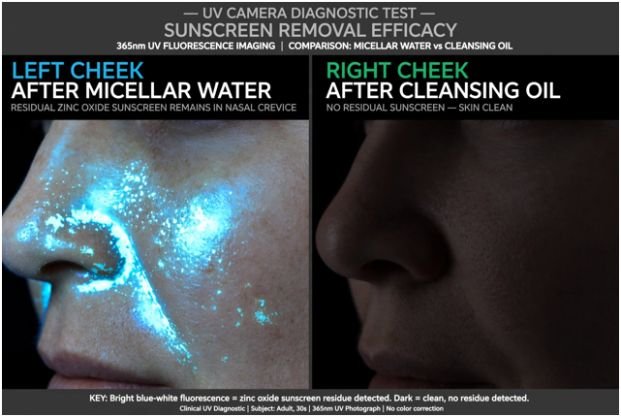
To assess real-world performance, I applied SPF 50 water-resistant zinc oxide sunscreen to both cheeks, allowed it to set for six hours, and examined the cleansing outcomes under a specialized ultraviolet diagnostic camera.
The results were stark. The micellar water cheek retained visible sunscreen deposits inside nasal crevices and hairline margins even after three soaked cotton pads. Worse, the repeated friction needed to lift the water-resistant film caused localized redness across the cheekbone. The American Academy of Dermatology (AAD) repeatedly advises minimizing friction during cleansing to prevent triggering barrier degradation and inflammatory flares.
The cleansing oil cheek rinsed completely clear of UV markers in under 45 seconds. The fluid oil suspended the dense mineral filters effortlessly, allowing them to rinse down the drain with zero mechanical drag.
Choosing Your First Cleanse by Skin Type and Lifestyle
Your selection should align with your barrier status, skin sensitivities, and daily routine.
When to Pick a Cleansing Oil
Cleansing oil remains my go-to recommendation for resilient, dry, combination, or blackhead-prone skin. It delivers thorough cleansing power for anyone wearing water-resistant cosmetics, matte primers, or chemical sunscreens. If you regularly use active treatments—such as wondering can you use niacinamide with vitamin c together—you need a clean canvas to prevent product pilling and localized irritation.
Caution: Avoid heavy carrier oils with high oleic acid profiles (like pure olive, wheat germ, or coconut oil) if you suffer from fungal acne (Malassezia folliculitis). Opt instead for 100% hemisqualane, caprylic triglycerides, or mineral oil bases.
When Micellar Water Makes Sense
Micellar water is an ideal rescue cleanser under specific conditions:
- Active Ocular Inflammation: Blepharitis or sensitive eyes that react poorly to oil ingress.
- Lash Extensions: Oil-free micellar cleansers protect lash glue integrity.
- Post-Procedure Skin: Delicate post-laser or post-peel skin unable to tolerate manual oil massaging.
- Travel or Waterless Conditions: Camping, post-flight refreshes, or gym-bag touch-ups.
Always splash lukewarm water over your skin after using micellar water. Leaving surfactant monomers resting on your skin overnight degrades protective stratum corneum lipids and causes chronic dryness.
How to Execute the Two-Step Routine Flawlessly
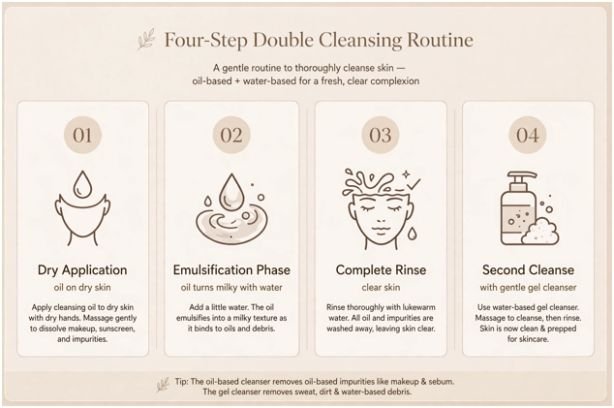
A double cleanse succeeds or fails based on technique.
- The Dry Application: Dispense two pumps of cleansing oil directly onto dry hands and massage over completely dry skin for 45 seconds. Do not wet your face first; moisture creates a premature emulsion barrier that stops the oil from binding with sebum.
- The Emulsification Phase: Splash lukewarm water onto your hands and continue massaging. Watch the clear fluid transform into a milky white liquid. This step breaks the surface tension and activates the surfactants.
- The Complete Rinse: Splash lukewarm water over your face until skin feels smooth and weightless, not slippery or coated.
- The Second Cleanse: Follow immediately with a low-pH, non-stripping gel or cream wash to clear water-soluble dust and residual surfactants.
- Lock in Moisture: Finish your evening regimen with targeted serums and a barrier cream or the best lightweight gel moisturizer for humid weather to seal in hydration.
Double Cleansing FAQs
1. Can I double cleanse using micellar water twice?
No, using micellar water twice doubles mechanical friction and leaves excess surfactant film without loosening deep pore plugs.
2. Will a cleansing oil trigger acne breakouts?
No, provided the formula uses gentle emulsifiers that rinse completely clean and avoids heavy, comedogenic base oils.
3. Does micellar water eliminate the need for a second wash?
No, micellar water leaves behind surfactant residues that can irritate the lipid barrier if not rinsed away with water or a second cleanser.
4. Is double cleansing necessary if I do not wear makeup?
Yes, daily water-resistant sunscreen, airborne pollution, and oxidized sebum still require an oil-based phase to fully break down.
The Final Wash: Stop Scrubbing, Start Dissolving
Rubbing your face with dry cotton pads to remove waterproof makeup is an unnecessary stress test for your skin barrier. While micellar water remains a convenient backup for quick touch-ups or late nights, cleansing oils deliver a superior cleanse by solubilizing stubborn debris with zero friction. Swap the cotton rounds for an emulsifying cleansing oil, pair it with a balanced second wash, and let chemical affinity do the heavy lifting.
Leave a Reply