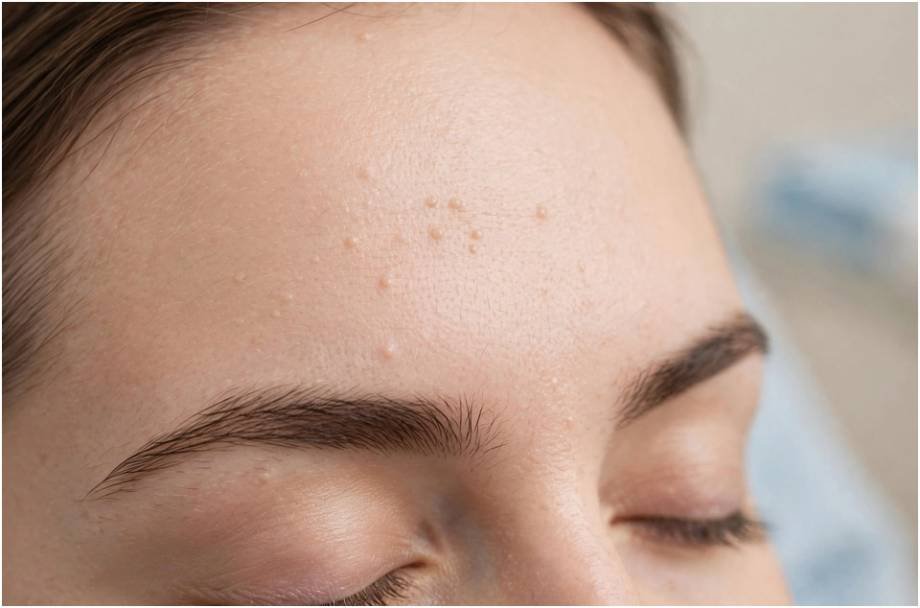
Those tiny, flesh-colored bumps across your brow line feel like sandpaper, refuse to come to a head, and turn into angry red cysts the second you squeeze them. Learning how to get rid of closed comedones on forehead zones requires understanding cellular mechanics rather than reaching for an aggressive facial scrub.
I spent months fruitlessly attacking my own forehead congestion with harsh walnut shells and pore strips. The bumps only multiplied. True clearing happened only when I swapped brute force for follicular cell turnover. Here is the exact clinical approach that dissolves these sealed blockages at the root.
Why Forehead Comedones Refuse to Pop or Drain
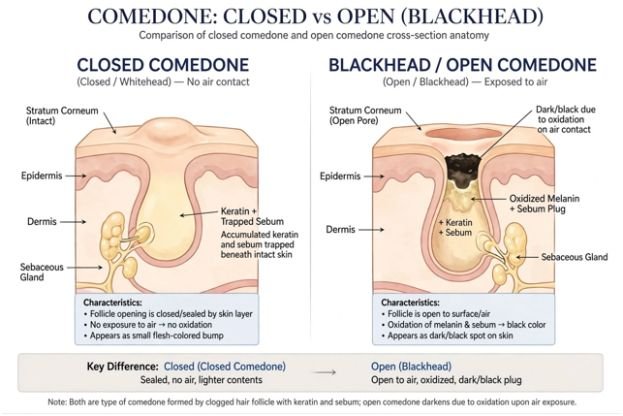
A closed comedone forms when a pore’s exit canal becomes completely blocked by compacted dead keratinocytes and sticky sebum. Unlike an open comedone (a blackhead), where the follicle opening remains dilated and oxidizes into a dark plug, a closed comedone retains a microscopic roof of epidermal tissue.
CLOSED COMEDONE BLACKHEAD (OPEN)
┌───────────────────────────┐ ┌───────┐ ┌───────┐
│ Intact Layer of Skin │ │ Skin │ OPEN │ Skin │
├───────────────────────────┤ ├───────┴─── ───┴───────┤
│ Keratin + Trapped Sebum │ │ Oxidized Melanin/Sebum │
│ (No air contact = flesh) │ │ (Air contact = black) │
└───────────────────────────┘ └───────────────────────────┘
Because the plug has no contact with ambient air, it stays skin-toned. Because an epithelial layer seals the opening, squeezing it merely fractures the inner follicular wall. That ruptures sebum into your dermis, triggering instant inflammatory acne.
The Microcomedone Trap Beneath the Skin
Every blemish starts invisibly as a microcomedone weeks before surfacing. According to the American Academy of Dermatology, abnormal hyperkeratinization—the failure of shedding pore cells to desquamate properly—causes cells to stick together like wet leaves in a gutter.
If your natural sebum contains higher ratios of squalene peroxides, that oil acts as mortar, locking those dead cells into a stubborn, solid plug.
The Hairline Factor: Pomade Acne vs. Fungal Overgrowth
The forehead sits directly in the splash zone of hair styling oils, shampoos, and conditioners. Heavy silicones, coconut oil, and styling waxes migrate onto the brow line while you sleep or sweat. This reaction, clinically designated acne cosmetica, creates dense clusters of comedones along your upper third of the face.
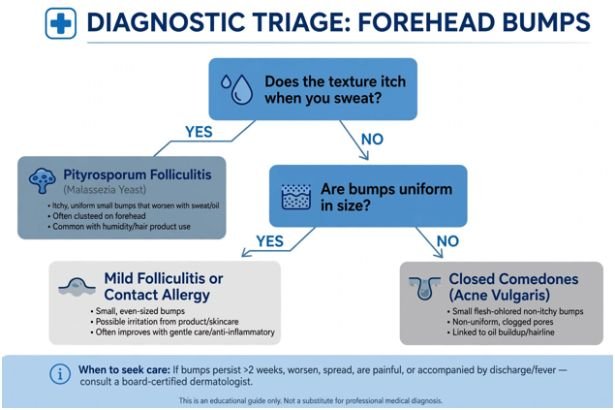
DIAGNOSTIC TRIAGE: FOREHEAD BUMPS
│
Does the texture itch when you sweat?
/ \
YES NO
/ \
Pityrosporum Folliculitis Are bumps uniform in size?
(Malassezia Yeast) / \
YES NO
/ \
Mild Folliculitis Closed Comedones
or Contact Allergy (Acne Vulgaris)
However, if your forehead bumps are completely uniform in size, look like pinpoint red dots, and itch after a workout, you might not have acne at all.
A clinical review in the Journal of Clinical and Aesthetic Dermatology points out that Pityrosporum folliculitis (an overgrowth of Malassezia yeast within the hair shaft) is routinely misdiagnosed as comedonal acne.
Applying traditional acne oils or heavy creams to fungal overgrowth feeds the yeast, making the texture significantly worse.
The Core Protocol to Dissolve Closed Follicles
Scrubbing cannot remove a problem that lives beneath an intact epithelial sheet. You must chemically thin that roof while accelerating follicular purging from underneath.
Topical Retinoids: Adapalene 0.1% vs. Tretinoin Formulations
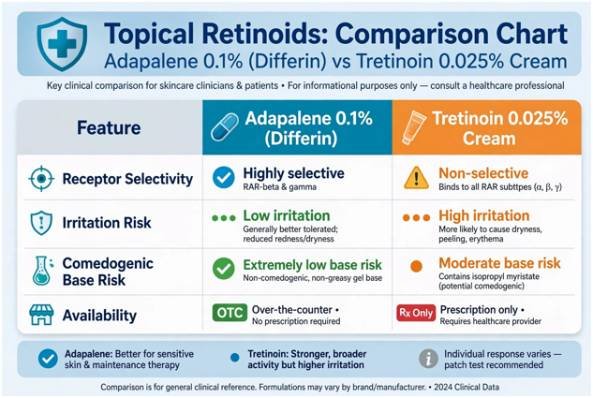
Topical retinoids remain the absolute standard for clearing non-inflammatory comedones. They bind to retinoic acid receptors (RARs) inside the skin cells, commanding the follicle lining to shed neatly rather than clump.
| Metric | Adapalene 0.1% (Differin) | Tretinoin 0.025% Cream |
| Receptor Selectivity | Highly selective for RAR-$\beta$ and RAR-$\gamma$ | Non-selective (RAR-$\alpha$, $\beta$, $\gamma$) |
| Irritation Risk | Low to moderate | High |
| Comedogenic Base Risk | Extremely low (aqueous gel) | Moderate (often formulated with isopropyl myristate) |
| Availability | Over-the-counter in the US | Prescription only |
Research indexed in PubMed Central demonstrates that Adapalene 0.1% matches Tretinoin 0.025% in clinical comedone reduction while causing markedly less erythema and peeling.
Furthermore, many patients struggle to clear forehead bumps on prescription Tretinoin cream because standard pharmacy vehicles use isopropyl myristate—an emollient ester notorious for triggering closed comedones in congestion-prone skin. If you opt for Tretinoin, request a micro-encapsulated gel or solution vehicle from your prescriber. Otherwise, start with over-the-counter Adapalene 0.1% gel.
Strategic Chemical Exfoliation Without Barrier Burnout
Pair your nightly retinoid work with targeted chemical acids:
- Salicylic Acid (BHA): As an oil-soluble beta hydroxy acid, salicylic acid cuts through sebum to loosen follicular debris. A 2% leave-on fluid or a dedicated morning wash cleans the inside of the pore lining.
- Glycolic or Lactic Acid (AHA): Alpha hydroxy acids dissolve the water-soluble cellular glue cementing the skin’s surface. This dissolves the thin roof trapping the closed comedone, allowing the retinoid to evacuate the plug.
Never layer leave-on AHAs/BHAs simultaneously with your retinoid in the same evening session. Doing so destabilizes your acid mantle, triggers contact dermatitis, and worsens the textural flare.
How I Restructured My Routine to Clear Stubborn Bumps
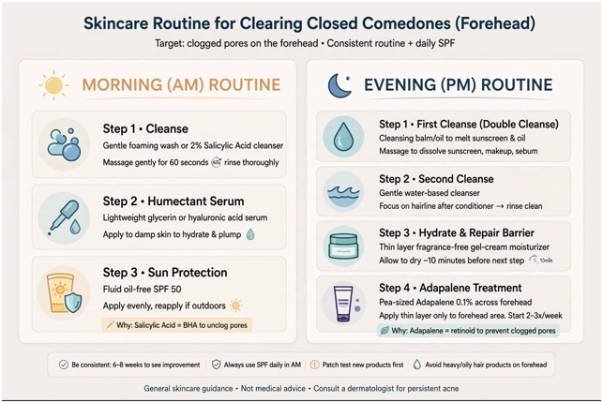
When clearing my forehead, the breakthrough arrived not from adding stronger products, but from removing hidden clog triggers and separating my actives.
MORNING (AM) ROUTINE
Step 1: Gentle foaming wash or 2% Salicylic Acid cleanser (leave on 60 seconds)
Step 2: Lightweight humectant (pure glycerin or hyaluronic acid serum on damp skin)
Step 3: Fluid, oil-free, non-comedogenic sunscreen (SPF 50)
EVENING (PM) ROUTINE
Step 1: First cleanse to melt sunscreen (weigh cleansing oil vs micellar water for double cleansing based on whether your skin tolerates emulsified plant oils)
Step 2: Gentle water-based cleanser (wash hairline and forehead AFTER rinsing conditioner)
Step 3: Thin layer of basic, fragrance-free gel-cream moisturizer; let dry 10 minutes
Step 4: Pea-sized amount of Adapalene 0.1% spread evenly across the entire forehead
Two physical habits proved equally crucial: I stopped using leave-in hair serums containing dimethicone near my hairline, and I swapped cotton pillowcases for clean ones twice a week.
When Your Face Hits Back: Managing the Transition
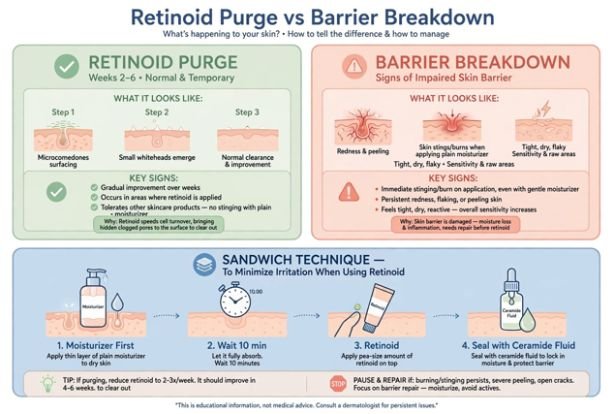
Expect a purge. Between weeks two and six, microcomedones will surface into small whiteheads as the retinoid speeds your shedding cycle. This is standard clearance.
However, if your skin begins to sting when applying plain moisturizer, you have crossed from a healthy purge into barrier breakdown. You need to pull back actives and actively repair damaged skin barrier from retinol before continuing your treatment.
Buffer your retinoid using the “sandwich technique”: apply moisturizer first, wait ten minutes, apply your retinoid, and seal with a light, non-comedogenic ceramide fluid.
Frequently Asked Questions About Forehead Texture
1. How long does it take for forehead closed comedones to go away?
Consistent use of topical retinoids and gentle chemical exfoliants typically yields noticeable clearance within 6 to 12 weeks.
2. Can I manually extract closed comedones with an extraction tool?
No, extracting closed comedones without an open follicular pore tears the surrounding epidermis and often causes deep cystic inflammation or permanent scarring.
3. Does drinking water clear closed comedones on the forehead?
Hydration supports general skin health, but it will not unclog follicular keratin plugs cemented by dead cells and sebum.
4. Will facial oils get rid of closed comedones?
No, pure facial oils lack keratolytic properties and frequently introduce comedogenic fatty acids that worsen forehead blockages.
Drop the Extractors, Step Away From the Mirror
Step back from the magnifying mirror and retire the stainless steel comedone extractors. Getting clear skin on your forehead is a game of biological patience, not manual warfare.
Give a stable topical retinoid eight full weeks to reset your follicular shedding, streamline your hair products to eliminate stray pore-clogging oils, and let cellular turnover do the heavy lifting for you.
Leave a Reply