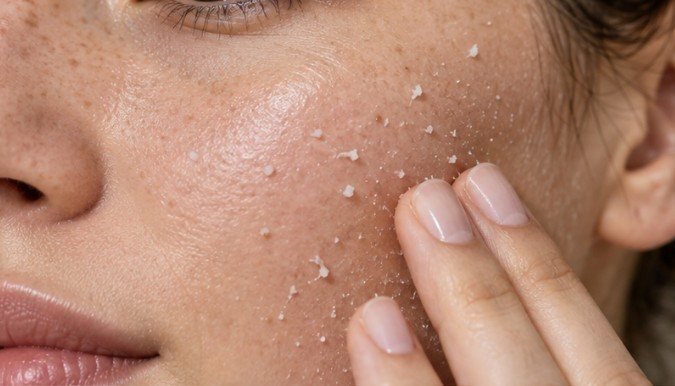
Skincare pilling can look like dry skin, but those tiny flakes may actually be your products rolling themselves off your face.
That distinction matters. Scrubbing harder or adding more moisturizer can make the problem worse. If you want to know how to stop skincare products from pilling, start with three changes: use smaller amounts, reduce friction between layers, and give each layer a short chance to settle before adding the next.
Research suggests application technique matters more than many people realize. In a study of 528 women, 41% experienced some pilling, with rubbing motions among the application methods associated with the most pilling events.
What Is Skincare Pilling, Exactly?
Pilling happens when a skincare or makeup layer forms visible little rolls, flakes, or balls as you apply another product over it. Instead of remaining as a smooth film, material collects and rolls across the surface. It is not automatically evidence that a product is “bad,” expired, or failing to absorb.
Several things can contribute simultaneously: too much product, repeated rubbing, multiple film-forming formulas, insufficient drying time, dry or flaky skin, or simply two formulas that do not layer gracefully.
The peer-reviewed pilling study found that sunscreen was involved in substantially more pilling events than foundation. The researchers also found associations between pilling and skin characteristics including lower hydration and oiliness.
That study has limitations. Its participants were women aged 20 to 49 in Guangzhou, China, and specific products were tested, so the percentages should not be treated as a prediction for every U.S. skincare user. Still, the findings offer something unusually useful: pilling is influenced by both the formula and what you do with it after it reaches your face.
The Fastest Way to Fix Pilling Mid-Routine
If your face starts pilling, stop rubbing. It’s like doing your lip care routine for dry lips.
Trying to massage the flakes away usually creates more friction and disturbs additional layers. Let the area settle briefly, then lightly lift loose material using clean fingertips or a soft, slightly damp pad. Press rather than scrub.
If only one small area is affected, there is usually no reason to wash your entire face.
Heavy pilling is different. If several layers are visibly rolling off, cleansing and rebuilding a simplified routine can produce a better result than repeatedly patching the surface.
The goal is not to force every product to stay on your face. It is to identify which step introduced the instability.
How to Stop Skincare Products From Pilling Step by Step
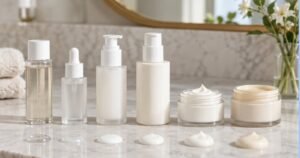
Start With Less Than You Think You Need
Layering problems become more likely when the skin is carrying several thick films.
You do not need to measure every serum precisely, but covering the face evenly is different from leaving a visibly wet layer. If a product is still sliding around when you begin the next step, experiment with a smaller amount.
The exception is sunscreen. Do not deliberately under-apply sunscreen simply because it pills. The U.S. Food and Drug Administration advises applying enough sunscreen to cover exposed skin and reapplying as directed.
Instead, simplify what goes underneath your sunscreen.
Apply Treatments Before Heavier Layers
The American Academy of Dermatology recommends cleansing first, followed by medications or treatments, then moisturizer and/or sunscreen, with makeup afterward.
For a more elaborate cosmetic routine, a useful extension is to move generally from thinner, more fluid textures toward creams and more occlusive products.
This is not an absolute chemistry law. A dermatologist-prescribed medication may require specific instructions that override cosmetic layering rules. Always follow prescription directions first.
Wait Long Enough for the Surface to Set
You do not need a five-minute timer between every serum.
For many routines, roughly 30 to 60 seconds is a reasonable practical starting point. What matters is the surface: the previous layer should no longer feel excessively wet or move around when gently touched.
A richer cream or sunscreen may need a little longer before makeup. If waiting makes no difference, timing is probably not the main problem.
Press Instead of Repeatedly Rubbing
This is one of the highest-value changes because it costs nothing. Spread the product lightly, then use gentle pressing or patting motions rather than repeatedly massaging the same area. The pilling study found circular and linear rubbing produced the highest numbers of pilling events among the application methods tested.
Think of the existing skincare as a film you are trying not to erase while placing the next film over it.
A Simple Pilling Troubleshooting Test
Changing five products at once tells you very little. Change one variable at a time.
| What you notice | Likely issue | Test first |
| Pilling begins after several layers | Product overload | Remove one nonessential step |
| One product always triggers it | Formula interaction | Test that product over bare moisturized skin |
| Pilling appears during rubbing | Excess friction | Press or pat instead |
| Skin flakes even without products | Dryness or irritation | Focus on gentle cleansing and moisturizing |
| Sunscreen pills over serums | Too many underlying layers | Simplify the morning routine |
For persistent problems, perform a miniature layering test indoors. Apply two suspected products to a small area of clean skin, wait between them, then repeat on another area using smaller quantities.
If reducing the quantity fixes it, the formulas may be compatible after all. If the same pair pills regardless of amount or waiting time, separating them between morning and evening may be simpler than forcing them together.
Does Silicone Automatically Cause Pilling?
No.
Dimethicone and other silicones often receive the blame because they can form smooth films over the skin. But and barrier products. Harvard Health notes that dimethicone is among ingredients used to support moisturizer texture and the skin’s outer surface.
The more useful question is not, “Does this contain silicone?”
Ask, “Does this specific combination pill on my skin under my normal application conditions?” Two well-formulated products can each work beautifully alone and still create an unpleasant texture when heavily layered together.
What If the “Pilling” Is Actually Flaking Skin?

This distinction is easy to miss.
Product pills often appear suddenly as you rub or layer skincare. True dryness may already be visible before the routine and can come with tightness, rough texture, itching, irritation, or stinging.
Over-exfoliation can worsen the problem. The American Academy of Dermatology warns that exfoliating too aggressively can contribute to redness and irritation and advises moisturizing afterward.
If your face stings, feels unusually sensitive, or remains flaky after cleansing, adding another exfoliating acid simply to create a “smoother canvas” may backfire.
Cleveland Clinic dermatology guidance similarly identifies over-exfoliating and harsh cleansing as potential contributors to skin-barrier damage and recommends gentle care and regular moisturizing.
In that situation, treat the skin problem first and the cosmetic layering problem second.
A Better Morning Routine for Pilling-Prone Skin
Complexity is often the enemy of a smooth finish.
Harvard Health notes that an effective basic routine does not need numerous bottles and can center on cleansing, addressing specific skin needs, moisturizing when appropriate, and sun protection.
If mornings are consistently problematic, try cleanser, one essential treatment, moisturizer if needed, sunscreen, then makeup.
Move optional serums to nighttime one at a time.
This approach has another advantage: it makes troubleshooting possible. Ten products create dozens of potential interactions. Four products make it much easier to find the one step that destabilizes everything above it.
Frequently Asked Questions
1. Why do my skincare products pill even when I wait between layers?
Waiting cannot fix every formula interaction. Reduce product quantity, minimize rubbing, and test the products individually. If the same pair repeatedly pills, use them at different times.
2. Can dry skin cause skincare pilling?
Yes. Dry, flaky skin can create an uneven surface, and research has associated lower skin hydration with greater pilling in some participants. Persistent flaking may require barrier-focused care rather than more exfoliation.
3. How long should I wait between skincare products?
About 30 to 60 seconds is a useful starting point, but there is no universal medically required interval. Allow the previous layer to settle before applying the next.
4. How do I stop skincare products from pilling under makeup?
Use fewer morning layers, apply smaller amounts, avoid vigorous rubbing, let sunscreen settle, and test whether your moisturizer, sunscreen, or primer is the step causing the problem.
The Smoothest Routine Is Usually the Simplest One
Pilling can make an expensive routine seem defective, yet the solution often costs nothing.
Use only the layers you genuinely need, apply them in a sensible sequence, give each one a moment to settle, and stop repeatedly rubbing the skin. If one combination continues rolling into flakes, separate those products rather than trying to overpower the problem with more skincare.
Most importantly, do not confuse cosmetic pilling with damaged, flaky skin or reduce necessary sunscreen simply to improve texture. A routine should work as a system. If the layers keep fighting one another, fewer layers are often the smartest upgrade.
Leave a Reply