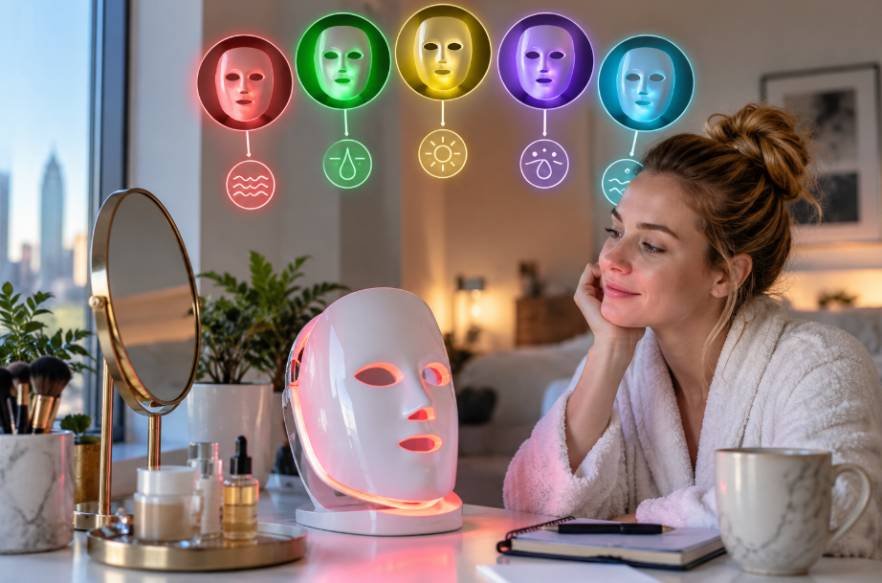
I started noticing how quickly LED masks have moved beyond the simple red-light devices I first saw online. Some now offer several wavelengths, each marketed for a different skin concern, and that made me curious about what those colors actually mean. A mask can look futuristic, but the useful question is what light reaches the skin, and why?
I also found that the number of colors can be misleading. A mask with seven settings is not automatically better than one with two well-chosen wavelengths. Once I looked past the color names, the useful details were wavelength, treatment intensity, coverage, session length, and how consistently the device could be used.
Why LED Masks Use Multiple Wavelengths
LED light therapy delivers specific wavelengths of light to the skin without the intense heat associated with some other energy-based treatments. Wavelength is measured in nanometers, and it influences how light interacts with tissue. Different wavelengths can therefore be selected for different skincare goals.
That is the basic idea behind LED face masks with multiple light wavelengths. A device can combine ranges or let users switch easily. Evidence for individual wavelengths is not equally strong.
What Blue Light Does

Blue light, often around 415 nanometers, is commonly used in LED devices designed for acne-prone skin. It works near the skin surface and can affect acne-associated bacteria, making it relevant for mild inflammatory breakouts.
Blue light is not a universal acne treatment. Home devices are generally less powerful than professional equipment, and combination treatments using blue and red light are also common.
What Red Light Does
Red light, commonly found around 630 to 660 nanometers, is one of the most established features in consumer LED masks. It reaches deeper than blue visible light and is used in photobiomodulation, a process involving light-driven cellular responses.
For skincare, red light is associated with collagen-related processes, fine-line appearance, and visible inflammation. Results are gradual, with regular use over several weeks being a more realistic expectation.
What Near-Infrared Light Adds
Near-infrared light sits beyond visible red light, with many skincare devices using wavelengths around 830 to 850 nanometers. Because it can penetrate farther into tissue, it is often paired with red light in photobiomodulation devices.
Near-infrared exposure is intended to influence biological processes in deeper tissue. Research continues to explore these effects, so marketing claims should be viewed alongside a device’s specifications and evidence.
Where Yellow, Green, Purple, and Cyan Fit
Multi-color masks often add yellow or amber, green, purple, or cyan. These options can make a device seem more versatile, but their evidence should be interpreted carefully.
Yellow or amber light is commonly marketed for visible redness and soothing sensitive-looking skin. Green light is promoted for a brighter, more even-looking complexion. Purple generally combines red and blue light, while cyan, around 490 nanometers, is marketed as a calming option.
These uses do not all have the same clinical support. Color labels alone are not proof that a wavelength will produce a particular result.
More Wavelengths Does Not Automatically Mean Better
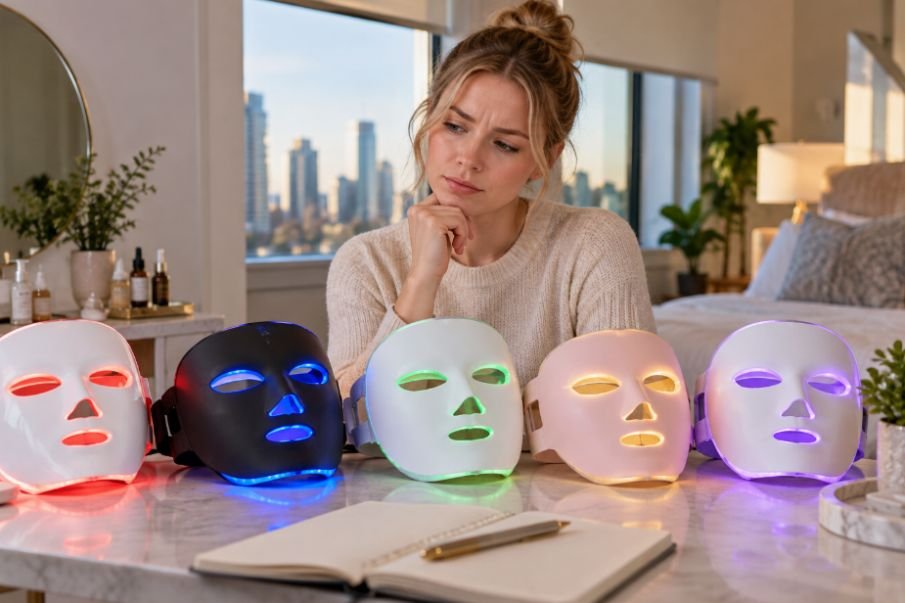
A long list of colors may look impressive, but wavelength is only one part of the equation. Irradiance, or the amount of light delivered over an area, affects the dose reaching the skin. Treatment duration and frequency matter too.
A useful device should provide good facial coverage, fit securely, and make the recommended schedule easy to follow. Eye protection deserves attention, particularly with bright visible light or photosensitizing medications.
The appeal of wearable beauty technology for skincare routines is convenience. A hands-free mask can fit a routine more easily than a clinic treatment. That matters because LED therapy is generally a consistency game. Ten minutes used several times a week can be more useful than an elaborate device sitting in a drawer.
How to Choose a Multi-Wavelength Mask
Start with the skin concern you actually want to address. For acne, look for a clearly specified blue wavelength and, where relevant, red light. For visible signs of aging, red and near-infrared are more commonly associated with the intended use.
Then check the technical information. Look for disclosed wavelengths in nanometers, recommended session length, treatment frequency, and safety guidance. FDA clearance can also be worth checking for devices making specific medical or cosmetic claims, but clearance applies to the particular device and indication, not every LED mask.
A practical routine might involve cleansing, using the mask as directed, and continuing with normal skincare. More sessions are not necessarily better.
That is why high-tech facial devices for everyday skincare should be judged by usability rather than novelty. A device can have multiple modes and wavelengths yet still be a poor choice if it is uncomfortable or difficult to use consistently.
What Results Should You Expect?
LED therapy is not an overnight transformation. Improvements, when they occur, tend to develop with repeated use. Acne-focused devices may require several weeks, while changes in the appearance of fine lines and overall skin quality can take longer.
LED masks can complement a skincare routine, but they do not replace proven acne medications, sunscreen, or professional treatment when needed. Think of the mask as one tool, not the entire toolbox.
FrequentlyAsked Questions
1. Which LED wavelength is best for acne?
Blue light is commonly used for acne-prone skin because it can affect acne-associated bacteria. Red light is also frequently paired with blue light.
2. Is red light better than blue light?
Neither is simply better. They serve different purposes, and the appropriate choice depends on the skin concern and device specifications.
3. Do multiple LED wavelengths work better?
Not automatically. Wavelength, dose, irradiance, coverage, treatment time, and consistency all influence how useful a device may be.
4. How often should an LED mask be used?
Follow the manufacturer’s schedule. Most home devices require repeated sessions over several weeks rather than occasional use.
Choosing Light With a Little More Perspective
The most useful way to look at a multi-wavelength mask is not as a collection of trendy colors, but as a controlled light-delivery device. Red, blue, and near-infrared have different roles, while newer color options deserve a measured look at the evidence. Once wavelength, dose, safety, and usability are considered together, the technology becomes easier to understand.
The best mask is rarely the one with the longest menu. It is the one that fits the goal, provides clear specifications, feels comfortable enough to use, and earns a regular place in the routine.
Leave a Reply