
Layering your serums in the wrong order wastes money and triggers irritation. When you learn the correct morning vs night skincare routine steps order, your skin shifts from congested to resilient. Morning skin requires protection against solar radiation and pollution; nighttime skin demands repair, cell turnover, and deep barrier replenishment.
AM: Cleanse ➔ Tone ➔ Vitamin C ➔ Light Moisturizer ➔ Sunscreen (Protect)
PM: Double Cleanse ➔ Tone ➔ Retinoid / Acid ➔ Lipid Barrier Cream (Repair)
The Biological Reason Your AM and PM Routines Must Differ
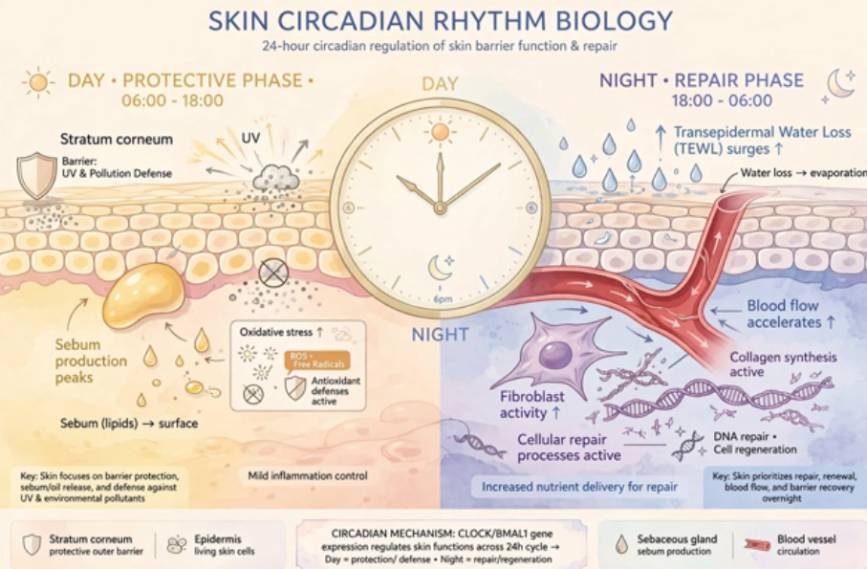
Your skin operates on a precise circadian rhythm. During the day, sebum production peaks to create a natural shield while the stratum corneum fights UV damage and oxidative stress. At night, transepidermal water loss (TEWL) surges, skin blood flow accelerates, and nuclear cellular repair mechanisms activate.
Applying heavy occlusives or light-sensitive actives at the wrong hour works against this biology. The universal rule of formulation physics is simple: apply products from thinnest to thickest consistency, following water-based solutions before oil-based layers.
Morning Skincare Routine: Step-by-Step Defense Order
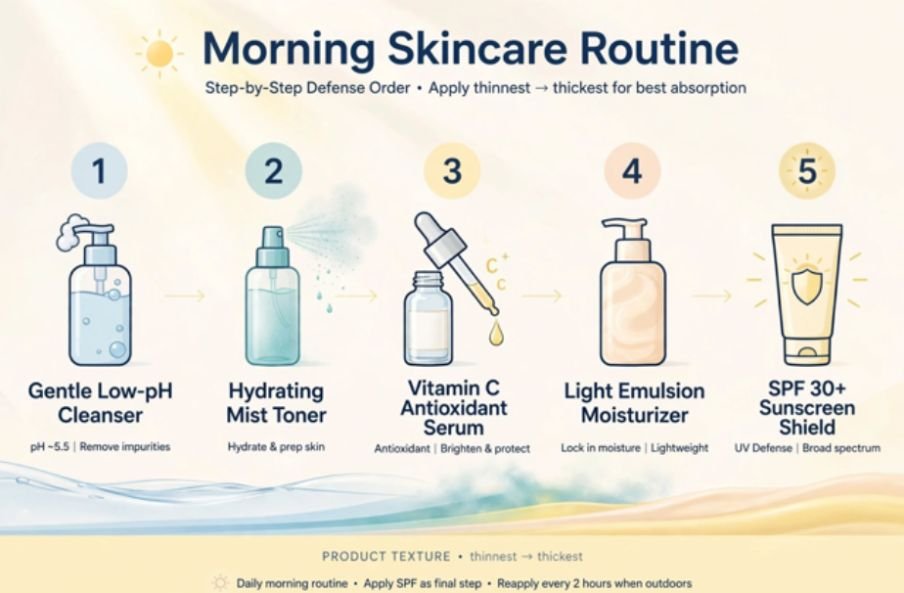
The daytime sequence focuses entirely on non-negotiable photoprotection and neutralizing free radicals before they degrade your collagen lattice.
+————————————————————————-+
| MORNING STEP SEQUENCE |
| |
| [Cleanser] ──> [Hydrating Mist] ──> [Antioxidant] ──> [Moisturizer] ──> [SPF 30+] |
| Gentle Water-based Vitamin C Light Emulsion Shield |
+————————————————————————-+
Step 1: Low-pH Water-Based Cleanser
Rinse away overnight sebum and shed corneocytes without stripping lipids. The American Academy of Dermatology Association (AAD) emphasizes washing with a non-abrasive, alcohol-free formula to keep your acid mantle intact. If your skin leans dry, a splash of lukewarm water suffices.
Step 2: Hydrating Toner or Essence
Pat a water-weight humectant containing glycerin, panthenol, or beta-glucan into damp skin. Damp skin acts like a sponge; it exhibits significantly higher permeability for subsequent actives than parched tissue.
Step 3: Antioxidant Defense (Vitamin C)
Apply 4 to 5 drops of L-ascorbic acid (10–15%) or a stabilized derivative. Vitamin C scavenges free radicals generated by ambient UV exposure and pollution, boosting the photoprotective efficiency of your sunblock. Readers frequently ask, can you use niacinamide with vitamin c together? Yes; modern stabilized formulations pair well without causing flushing or destabilizing your formulation.
Step 4: Lightweight Hydrator
Use a fast-absorbing gel-cream or light emulsion. This step replenishes the natural moisturizing factor (NMF) without creating an oily film that causes daytime makeup or sunscreen to pill.
Step 5: Broad-Spectrum Sunscreen
Apply a nickel-sized amount of broad-spectrum SPF 30 or higher. As clinical guidance from the Cleveland Clinic outlines, sunscreen is your absolute final morning layer. Applying anything over it disrupts the protective chemical or mineral film.
Night Skincare Routine: Step-by-Step Recovery Order
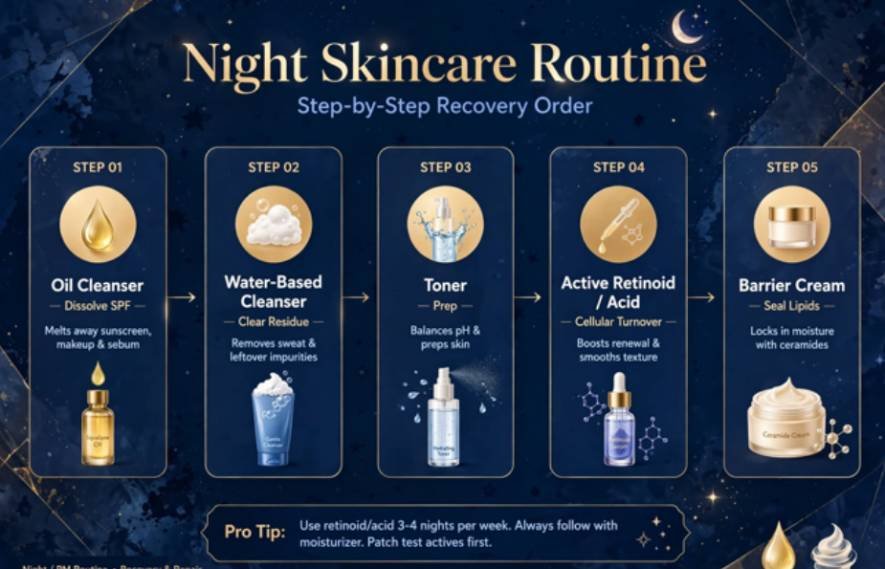
Night is when therapeutic transformation happens. By removing environmental debris and feeding the skin regenerative actives, you encourage cellular renewal.
+————————————————————————-+
| NIGHT STEP SEQUENCE |
| |
| [Oil Cleanse] ──> [Water Cleanse] ──> [Toner] ──> [Active (Retinoid)] ──> [Barrier Cream] |
| Dissolve SPF Clear Residue Prep Cellular Turnover Seal Lipids |
+————————————————————————-+
Step 1: The Evening Double Cleanse
Break down water-resistant sunscreen, particulate grime, and excess sebum with an oil cleanser or cleansing balm. Massage it onto dry skin for 45 seconds, emulsify with warm water, and rinse. Follow immediately with your gentle water-based foaming or gel cleanser to leave pores completely clear.
Step 2: Balancing Prep & Penetration Enhancers
Apply a soothing, alcohol-free toner to normalize surface pH. When clearing stubborn congestion, this is the prime spot to address texture and learn how to get rid of closed comedones on forehead using gentle chemical exfoliants.
Step 3: High-Performance Actives (Retinoids or Exfoliants)
Apply your cell-signaling actives to completely dry skin.
- Retinoids (Retinol, Retinal, Tretinoin): Accelerate cellular turnover and stimulate collagen synthesis.
- Chemical Exfoliants (AHA/BHA): Dissolve the desmosomes binding dull, dead cells together.
Clinical tip: Alternate these actives across different nights using a skin-cycling model to prevent moisture barrier collapse.
Step 4: Barrier Lipids and Occlusives
Seal your treatment with a restorative night cream rich in ceramides, physiological fatty acids, and cholesterol. Research cataloged by the National Institutes of Health shows that disciplined post-wash moisturizing drastically decreases erythema and improves barrier function. For severely dry complexions, lock in moisture with two drops of squalane oil over your cream.
Layering Pitfalls: Ingredient Collisions to Stop Making
| Problem Combination | Why It Fails | Safe Correction |
| Retinol + Glycolic Acid | Simultaneously strips the barrier and spikes inflammation. | Separate them: use AHAs on Monday, Retinol on Tuesday. |
| Vitamin C + Pure Retinol | Requires drastically different pH levels to remain bioavailable. | Keep Vitamin C in the AM; reserve Retinol for the PM. |
| Sunscreen Mixed Into Cream | Dilutes UV filter concentrations and creates uneven protection. | Apply moisturizer first, allow 60 seconds to dry, then apply SPF. |
| Active Over Occlusive | Vaseline or thick petrolatum prevents water-soluble serums from absorbing. | Always apply thin serums before dense petroleum-based ointments. |
Frequently Asked Questions
1. Can I wash my face with only water in the morning?
Yes, dry and sensitive skin types benefit from a plain water rinse to preserve natural surface lipids.
2. How long should I wait between skincare steps?
Wait 30 to 60 seconds for serums to dry down, and let moisturizer set for two full minutes before applying sunscreen.
3. Do I apply eye cream before or after facial moisturizer?
Apply eye cream before heavy face creams so delicate orbital skin absorbs the concentrated ingredients directly.
4. Can I use hyaluronic acid morning and night?
Yes, hyaluronic acid is a non-reactive humectant suitable for both routines when applied to damp skin.
Stop Overcomplicating Your Routine
Your skin isn’t a lab experiment—it’s a living barrier that values predictability over endless product stacking. Once you align your active ingredients with your body’s circadian clock, results follow naturally. Pick your core essentials, master the viscosity rule, and stay consistent for eight weeks before swapping products.
Leave a Reply